Understanding Memory: Types, Processes, and the Role of the Brain
Explore the fascinating world of memory, a vital cognitive function that encompasses various types such as explicit and implicit memory. Discover how the hippocampus and cerebellum play crucial roles in memory formation, storage, and retrieval. Learn about encoding techniques, including levels of processing and dual coding theory, as well as the differences between sensory, short-term, and long-term memory. With insights on retrospective vs. prospective memory and the significance of schemas, this overview offers valuable knowledge for students and anyone interested in the workings of the mind.

Understanding Memory: Types, Processes, and the Role of the Brain
E N D
Presentation Transcript
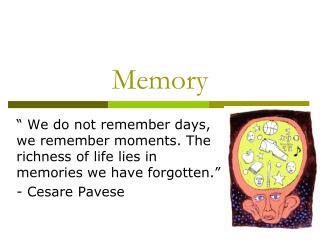
Memory “ We do not remember days, we remember moments. The richness of life lies in memories we have forgotten.” - Cesare Pavese
Explicit Intentional recollection Conscious effort Hippocampus involved Ex: remembering vocabulary for a psych quiz Implicit Remembering things you didn’t intend to store Unconscious processes involved Unaffected by amnesia, age, or drugs Cerebellum involved Ex: What did you have for dinner last night? Ex: Motor skills Memory Systems
Declarative (Endel Tulving)- factual information handled by hippocampus & areas of the cortex Episodic- personal facts and experiences Like an autobiography Maybe unique to humans Ex: first day of school Semantic- general, factual knowledge Ex: knowing the state capitals Like an encyclopedia NonDeclarative/Pro-cedural- actions and skills (muscle memory) Little conscious awareness Ex: riding a bike Performance decreases if you think too much Doesn’t decline much Cerebellum and amygdala Memory Systems
Retrospective v. Prospective Memory Retrospective Prospective Remembering to perform actions in the future Ex: walk the dog • Remembering events from the past or previously learned info • Ex: who won the Super Bowl last year?
3 Key Processes of Memory Encoding Storage Retrieval Encoding- forming a memory code Storage- maintaining encoded information over time Retrieval- recovering information from memory stores
Encoding • Experiment Time! • Levels of Processing • Structural • Phonemic • Semantic (deepest level) • Encoding Techniques • Elaboration • Visual Imagery- concrete v. abstract words • Dual Coding Theory- memory is enhanced by forming semantic and visual codes • Self-referent encoding- deciding if info is personally relevant
Storage • Information Processing Theory- incoming information passes through 2 temporary areas of storage (sensory & short-term) and then is transferred to long-term storage Sensory Short Term Long Term (working)
Sensory Memory • Allows sensation to linger for a brief moment after stimulus is presented • Less than a second • Ex: afterimage • Experiment with Trigrams!
Practice Round AGB TJK WLP
MIDDLE TJK
Round 1 MKL WDC BGT
BOTTOM BGT
Round 2 ZXA QKI NHY
TOP ZXA
Round 3 XCV BHY OTR
TOP XCV
Round 4 DWS VFT GXC
BOTTOM GXC
Round 5 FVG HYU AVH
MIDDLE HYU
Round 6 KRG XDT WLP
BOTTOM WLP
Short-term memory (STM) • Limited capacity (7-9 items) • Limited duration (up to 20 sec.) • Rehearsal causes STM to last longer • Interference • EXPERIMENT! • Chunking • EXPERIMENT! • Serial-Position Effect (primacy/recency)
Bed- Rest- Awake- Tired- Dream- Snooze- Blanket- Doze- Slumber- Snore- Nap- Yawn- Drowsy-
Nurse • Sick • Lawyer • Medicine • Health • Hospital • Dentist • Physician • Ill • Patient • Doctor • Office • Stethoscope • Surgeon • Clinic
Long-Term Memory (LTM) • Unlimited capacity over long periods of time • Flashbulb Memories- vivid & detailed recollections of momentous events in our life • Schema (prototype)- mental categories about a particular object based on a particular experience • Stored info is often organized around schemas • Semantic Network- related concepts are joined closer together