Download
1 / 28
280 likes | 401 Views
In the 19th century, Britain struggled with true democracy, leading to the Reform Bill of 1832, which primarily benefited the middle class. The Chartist movement sought broader representation. Political power resided with the elite, while "proper" English behavior adhered to traditional norms. The Pankhursts advocated for women’s rights with organized protests. Meanwhile, France transitioned from the Paris Commune to the Third Republic, facing instability and division during the Dreyfus Affair. This era also saw Canada and Ireland developing their identities amidst struggles for autonomy and the Great Famine's impact. Technological advancements transformed lives, while Darwin’s and Mendel’s theories challenged self-identity.

E N D
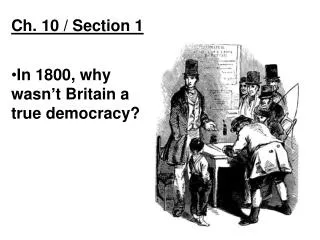
Ch. 10 / Section 1 • In 1800, why wasn’t Britain a true democracy?
Why did Parliament pass the Reform Bill of 1832 and whom did it benefit?
How did France progress from the Paris Commune to the Third Republic?
Ch.10 / Section 2 • How did the Dominion of Canada develop?
How was the settlement of Australia and New Zealand in the 19th Century similar to America?
What was the traditional relationship of the Irish and English?
Why was the prospect of Home Rule or independence a problem? • *(How is this similar to Canada?)
How does Ireland’s status change in the first part of the 20th Century?
Ch.10 / Section 4 • How many ways did technological inventions change the quality of life in the late 1800’s?
Why was Charles Darwin the most controversial man of the 19th Century?
ROLE PLAY • PROPOSAL: the government should pass legislation to regulate working conditions and to make business owners provide healthcare for their workers.