Long Term Memory: Remembering and Forgetting
Long Term Memory: Remembering and Forgetting. Overview. Explicit and Implicit Memory Forgetting Decay, Interference, Retrieval Induced and Directed Forgetting Memory Distortion and False Memories Eyewitness Memory. Types of Memory. Explicit (Declarative) Semantic

Long Term Memory: Remembering and Forgetting
E N D
Presentation Transcript
Overview • Explicit and Implicit Memory • Forgetting • Decay, Interference, Retrieval Induced and Directed Forgetting • Memory Distortion and False Memories • Eyewitness Memory
Types of Memory • Explicit (Declarative) • Semantic • Episodic (including Autobiographical) • Implicit (Nondeclarative) • Procedural • Priming • Conditioning • Habituation and Sensitization
Explicit vs. Implicit Memory: Amnesia Cases • MT (Schacter, 1983) • HM – loss of temporal lobes due to epilepsy • Clive Wearing
Explicit vs. Implicit Memory:Prejudice • Prejudice seems to have declined in the last 50 years • People are less likely to indicate they hold prejudices when asked in surveys • Implicit Association Test
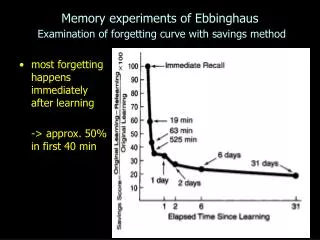
Decay Theory • Began with Ebbinghaus (1885) • Over time, unused memories weaken and fade away • Controversial • Implies only passage of time • Perhaps correct cues have not been rediscovered
Interference Theory • Memories interfere with each other • Proactive and Retroactive Interference • Reasons for Interference • Response competition • Unlearning
Retrieval Induced Forgetting • Remembering some aspects of an event can impair retrieval for other aspects of an event • Anderson, Bjork, and Bjork (1994) • Shaw, Bjork, and Handal (1995)
Directed Forgetting • Voluntary and purposeful forgetting of information • Sahakyan & Delaney, 2003- lists and the cost/benefit analysis • Joslyn and Oakes, 2004- diary study
Memory Distortion: Bias • Hastorf and Cantril (1954): They Saw a Game
False Memories • Lost in a Mall (Pickrell and Loftus, 1995) • Imagination Inflation- • Garry, Manning, Loftus, and Sherman (1996) • Thomas and Loftus (2002)
False Memories • Source misattribution • Advertising
The Impact of Eyewitnesses • Center for Wrongful Conviction study of 86 legally exonerated people found: • 53.5%: Eyewitness testimony played a role • 38.4%: Eyewitness was only evidence • In 32 cases, only 1 eyewitness • Mock Jury study • Eyewitness confidence is related to juror conviction
Event Factors • Exposure time • Detail Salience • Types of Facts • Duration, Speed, Distance
Witness Factors • Stress and memory • Weapon focus • Expectations • Biases • Cultural beliefs
The Misinformation Effect • Loftus, Miller and Burns (1978) • Leading/Suggestive questioning • Social contagion effects • Lineups and Mugshots