Mitosis
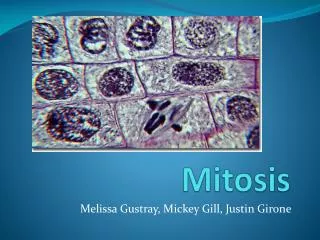
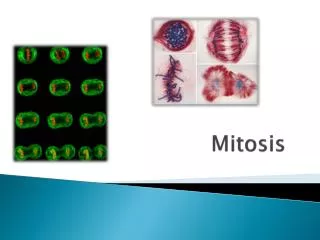
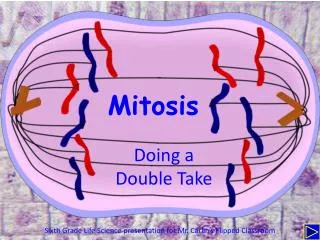
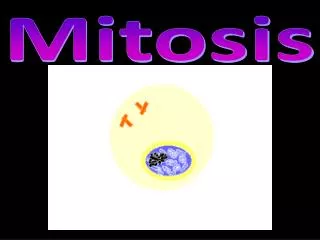
Mitosis is a vital process in cell division where chromosomes carry genetic information from one generation to the next. This process involves several stages: Prophase, Metaphase, Anaphase, and Telophase. During Prophase, the nuclear envelope breaks down and chromosomes become visible. In Metaphase, chromosomes align at the center of the cell. Anaphase features the separation of chromatids, while Telophase sees the formation of new nuclear envelopes. Finally, cytokinesis divides the cytoplasm, resulting in two new cells, completing the cell division process.

Mitosis
E N D
Presentation Transcript
What are Chromosomes? • Chromosomes • Carry the genetic information (traits) that are passed on from one generation of cells to the next. • Chromatids • A chromatid is one half of a chromosome • Each pair of chromatids is attached at an area called the centromere. Centromere Sister Chromatids
Prophase Plant Significant Events • Nuclear Envelope breaks down • Nucleolus disappears • Chromosomes become visible *Centrioles move to the poles of the cell (Animals Only) Nuclear Envelope Animal
Metaphase Plant Significant Events • Chromosomes line up across the center of the cell (metaphase plate) • Spindle fibers (apparatus) connect to each chromosome at the centromere Spindle Animal
Anaphase Plant Significant Events • Chromosomes are separated and pulled to opposite sides of the cell by the spindle fibers • This phase ends when the chromosomes stop moving Animal
Telophase Plant Significant Events • Chromosomes uncoil • Two new nuclear envelopes form Mitosis is complete, cell division is not. CYTOKINESIS • Division of the cytoplasm • Occurs at the same time as telophase • Plants: Cell plate forms • Animals: Cleavage furrow forms Animal
Cytokinesis Animal Plant VS. The cell membrane pinches in to form a cleavage furrow A cell plate forms midway between the divided nuclei.