Understanding Chemical Reactions: Campfire Examples and the Law of Conservation of Mass
This text explores the concept of chemical reactions, using the imagery of a campfire to illustrate how substances transform during heating. It discusses the changes that items like marshmallows undergo when exposed to fire and introduces key terminology such as reactants and products. The fundamental principle of the Law of Conservation of Mass is explained, affirming that in any chemical reaction, matter is neither created nor destroyed. By examining familiar scenarios, we gain a clearer understanding of these essential scientific concepts.

Understanding Chemical Reactions: Campfire Examples and the Law of Conservation of Mass
E N D
Presentation Transcript
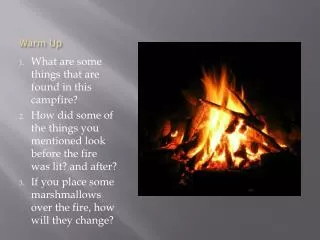
Warm Up What are some things that are found in this campfire? How did some of the things you mentioned look before the fire was lit? and after? If you place some marshmallows over the fire, how will they change?
Chemical Reactions Chapter 23
Describing Chemical Reactions • Before we being writing our chemical reactions, we need to first learn some of the basic terminology.
Chemical Reaction • A chemical reaction is a change in which one or more substances are converted to new substances.
The substances that react are called reactants. • The new substances that are produced are called products. (See examples…)
In the next examples, what are the reactants, and what are the products? • Hydrogen gas combines with oxygen gas to make water. • Zinc is added to sulfur to make ________________.
Law of Conservation of Mass • In a chemical reaction, matter is not created or destroyed.