Download
1 / 258
2.58k likes | 2.69k Views
This guide delves into the fundamental concepts of atomic structure and theories, including the behavior of electrons, energy level transitions, and types of radiation such as alpha, beta, and gamma. It also covers the periodic table's arrangement, trends in bonding, and molecular polarity. Key topics include stoichiometry, balancing reactions, and equilibrium principles. Explore the intricate details of pure substances and mixtures, along with important calculations involving moles, concentration, and reaction rates. Gain a solid understanding of matter and its interactions in the world of chemistry.

E N D
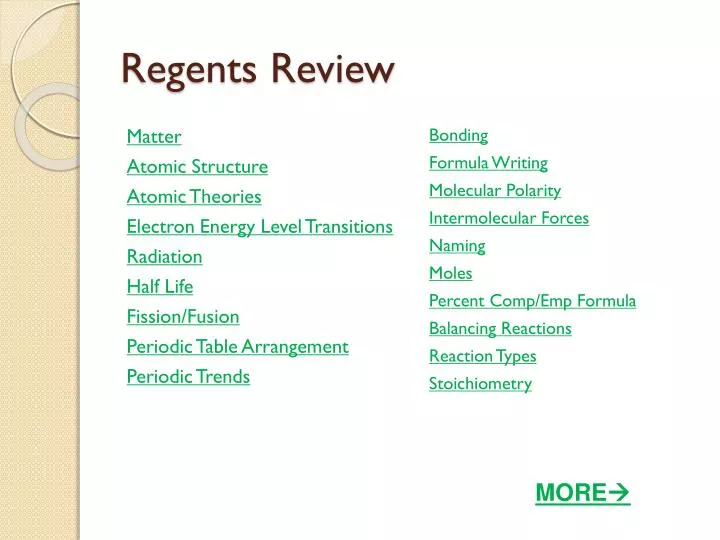
Regents Review Matter Atomic Structure Atomic Theories Electron Energy Level Transitions Radiation Half Life Fission/Fusion Periodic Table Arrangement Periodic Trends Bonding Formula Writing Molecular Polarity Intermolecular Forces Naming Moles Percent Comp/Emp Formula Balancing Reactions Reaction Types Stoichiometry MORE
More Phases Heat Equations Heating Curves Gas Laws Solutions/Solubility Molarity/Concentration Acids & Bases Neutralization/Titration Reaction Rates Equilibrium LeChatelier’s Principle Potential Energy Diagrams Reduction – Oxidation Electrochemical Cells Hydrocarbons Functional Groups Organic Reactions BACK
Matter • Anything that has mass and volume • Classified into 2 categories • Pure Substance • Sometimes just referred to as substances • Mixtures
Pure Substances • Element • simplest form of matter that has a unique set of properties. • Can’t be broken down by chemical means • Compounds • substance of two or more elements chemically combined in a fixed proportion • Can be broken down by chemical means
Mixtures • Physical blend of two or more substances • Two Types: • Homogeneous • Composition is uniform throughout • Heterogeneous • Composition is not uniform throughout
Separating Mixtures • Mixtures can be separated based on their physical properties • Boiling Pt, Freezing Pt, Density, Molecular Polarity, Particle Size • Process Examples • Filtering, Distillation, Evaporation, Crystallization, Chromatography, Desalination, Extraction
Atom • Atoms are made of subatomic particles • Protons • Neutrons • Electrons
Electron • Discovered first • Negative charge (-1) • Approx mass ~ 0u • Found outside of nucleus • Valence Electron • Electrons in the outermost energy level
Proton • Discovered second • Positive charge (+1) • Approx mass ~ 1u • Found inside nucleus
Neutron • Discovered last • No charge (0) • Approx mass ~ 1 atomic mass unit (u) • Just slightly larger than a proton • Found inside nucleus
Atomic Structure • Atoms have no net charge • # of electrons = # of protons • Nucleus • Center of atom, contains protons and neutrons • Positive charge
Atomic Structure • Atomic Number • Number of protons • All atoms of the same element have the same number of protons • Mass Number • Number of protons and neutrons in an atom • # of Neutrons = Mass Number – Atomic Number
Atomic Structure • Isotope • atoms of the same element with different number of neutrons • Ion • Atom or group of atoms that have gained or lost one or more electrons • Have a charge
Average Atomic Mass • Atomic Mass • Weighted average based on the relative abundance and mass number for all naturally occurring isotopes • Relative Abundance • Percent of each naturally occurring isotope found in nature
Atomic Mass Example • C-12 98.9% • C-13 1.1% • Carbon = 0.989*12 + 0.011*13 = 12.011u
Atomic Theories • Dalton’s Atomic Model • Also called Hard Sphere Model • First model • Plum Pudding Model • Uniform positive sphere with negatively charged electrons embedded within. • Came as a result of discovery of electron
Rutherford Gold Foil Experiment • Shot alpha particles at gold foil • Most went through, some were deflected back • Conclusions • Atom is Mostly Empty Space • Dense positive core (nucleus)
Atomic Theories • Rutherford Model • Dense positive core (nucleus) • Electrons moving randomly around nucleus • Bohr Model • Dense positive core (nucleus) • Electrons in specified circular paths, called energy levels
Atomic Theories • Wave Mechanical Model • Dense positive core (nucleus) • Electrons in orbitals • Regions of space where there is a high probability of finding an electron • Modern (current) Model • AKA Quantum Mechanical Model, Electron Cloud Model
Energy Level Transitions • Electrons can move between energy levels • Gaining energy will move an electron outward to a higher energy level • When an electron falls inward to a lower energy level, it releases a certain amount of energy as light
Energy Level Transitions • Energy released forms emission spectra
Radiation • Three Types • Alpha • Beta • Gamma
Radiation • Three Types
Symbols Alpha Beta Gamma
Transmutations • Any reaction where one element is transformed into a different element • Nuclear Reactions • Natural • Has one reactant • Alpha and Beta Decay • Artificial • Has more than one reactant • Particle Accelerators
Radioactive Decay • Radioisotopes will undergo decay reactions to become more stable • Alpha Decay • Beta Decay
Radioisotopes • You must know these radioisotopes and uses • I-131 - Diagnosing and treating thyroid disorders • Co-60 - Treating cancer • C-14 - Dating living organisms • Compared to C-12 • U-238 - Dating geologic formations • Compared to Pb-206
Half Life • Amount of time for half of a sample to decay into a new element • Table N
Half Life Equations Mass Left = Fraction Remaining Original Mass t = total amount of time elapsed T = half-life
Example • How many half lives does it take for a sample of C-14 to be 11430 yrs old?
Example • What fraction of P-32 is left after 42.84days?
Example • How long will a sample of Rn-222 take to decay down to 1/4 of the original sample? 7.646d
Practice • How much Carbon-14 was originally in a sample that contains 4g of C-14 and is 17145 years old? 32g
More Practice • How much 226Ra will be left in a sample that is 4797 years old, if it initially contained 408g? 51g
And One More…. • What is the half life of a sample that started with 144g and has only 9g left after 28days? 7d
Fission • Splitting of a larger atom into two or more smaller pieces • Nuclear Power Plants • One Example:
Fusion • Joining of two or more smaller pieces to make a larger piece • Sun, Stars • Examples
Energy Production • Energy is produced by a small amount of mass being converted to energy • This happens in both fission and fusion • More energy is produced by fusion than any other source • E=mc2
Fission vs. Fusion • Advantages of Fission • Produces a lot of energy • Disadvantages of Fission • Exposure to radiation • Produces material with long half life
Fission vs. Fusion • Advantages of Fusion • Produces more energy than fission • Disadvantages of Fusion • Have not been able to sustain stable reaction for energy production
Periodic Table • Arranged in order of increasing atomic number • Columns are called Groups • Numbered 1-18 • Rows are called Periods
Group Names • Group 1 - Alkali Metals • Group 2 - Alkaline earth metals • Group 17 – Halogens • Group 18 - Inert or Noble gases • Groups 3-11 – Transition Metals • Bottom 2 rows – Inner Transition