Understanding Similar Polygons: Ratios, Angles, and Dilation in Geometry
This guide covers the essential concepts of similar polygons, including the definition of similarity, the importance of equal ratios of corresponding sides, and congruent angles. Learn how to determine if two shapes are similar through dilation and reduction and find lengths and ratios with practical examples. Through the Quadratic Formula, we will also explore relationships within similar triangles. Understand how to work with angles and sides to solve problems effectively.

Understanding Similar Polygons: Ratios, Angles, and Dilation in Geometry
E N D
Presentation Transcript
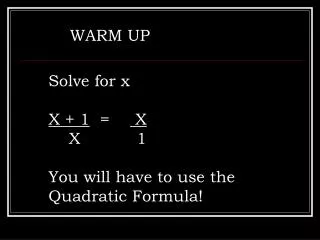
WARM UP Solve for x X + 1 = X X 1 You will have to use the Quadratic Formula!
8.2 Similarity Definition: Similar polygons are polygons in which: The ratios of the measures of corresponding sides are equal. Corresponding angles are congruent.
Similar figures: figures that have the same shape but not necessarily the same size. Dilation: when a figure is enlarged to be similar to another figure. Reduction: when a figure is made smaller it also produces similar figures.
Proving shapes similar: Similar shapes will have the ratio of all corresponding sides equal. Similar shapes will have all pairs of corresponding angles congruent.
Example: ∆ABC ~ ∆DEF D A 8 12 6 4 C E F B 5 10 Therefore: A corresponds to D, B corresponds to E, and C corresponds to F. The ratios of the measures of all pairs of corresponding sides are equal. = = =
Each pair of corresponding angles are congruent. <B <E <A <D <C <F
∆MCN is a dilation of ∆MED, with an enlargement ratio of 2:1 for each pair of corresponding sides. Find the lengths of the sides of ∆MCN. (0,8) C (0,4) E N M D (0,0) (3,0) (6,0)
Given: ABCD ~ EFGH, with measures shown. 1. Find FG, GH, and EH. B 6 F 9 4 A A E C 7 3 D G H 2. Find the ratio of the perimeter of ABCD to the perimeter of EFGH.
T61: The ratio of the perimeters of two similar polygons equals the ratio of any pair of corresponding sides. Given that ∆JHK ~ ∆POM, <H = 90, <J = 40, m<M = x+5, and m<O = y, find the values of x and y. First draw and identify corresponding angles.
K M J P O H <J comp. <K <K = 50 <K = <M 50 = x + 5 45 = x
<H = <O 90 = y 180 = y
Given ∆BAT ~ ∆DOT, OT = 15, BT = 12, TD = 9 Find the value of x(AO). A x O 15 D B 9 12 T Hint: set up and use Means-Extremes Product Theorem.