Download
1 / 12
120 likes | 240 Views
Explore the concepts of similar and congruent polygons in geometry. This discussion delves into the characteristics that define congruence—where figures exhibit the same shape and size—and similarity, where figures share the same shape but may differ in size. Learn how to identify and compare corresponding angles and sides in polygons, and understand the significance of scale factors. Through examples and exercises, develop your skills in determining polygon similarity and writing similarity statements.

E N D
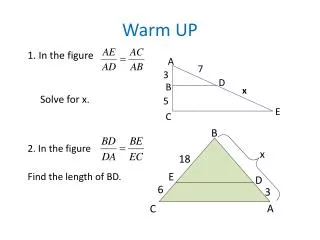
Warm UP • 1. In the figure • Solve for x. B x x 18 A E 7 D 3 6 3 D B 2. In the figure Find the length of BD. A C 5 E C
Discussion Recall what it means for two objects/figures to be congruent… Congruent figures have the same shape and size.
Discussion What can you conclude about the following figures? Similar figures have the same shape but not necessarily the same size.
Discussion Similar or Congruent?
Similar Polygons • Two polygons are SIMILAR (~) if their corresponding angles are congruent and the lengths of their corresponding sides are in proportion. Similarity Statement ABCD ~ EFGH B C Corresponding Angles F G Corresponding Sides E H A D
Example Are the polygons similar? If they are, write a similarity statement. Corresponding Angles B S 40 40 15 18 Corresponding Sides 30 25 R T 12 Scale Factor A C 20 68 72 68 72
Discussion • If two polygons are similar, then the ratio of the lengths of the two corresponding sides is called the scale factor. B S 40 Scale Factor 40 15 18 30 25 R T 12 A C 20 72 68 68 72
Discussion Examples What is the scale factor of the following polygons? 8 25 15 4 6 10 3 5 15 3 25 5 3 5
Discussion Example What is the scale factor of the following polygons? 21 3 16 8 2 1
Example Are the polygons similar? (List the corresponding angles & sides) If they are, write a similarity statementand the scale factor. A S 12 15 10 8 R T x x 6 9 B C