Solids
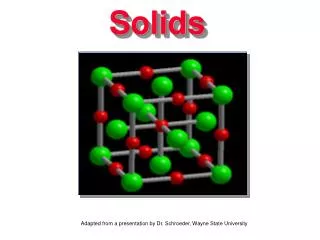
Solids. Adapted from a presentation by Dr. Schroeder, Wayne State University. Properties of Solids. 1. Definite shape, definite volume 2. Particles are CLOSE together 3. STRONG IM forces Often highly ordered, Rigid, incompressible. ZnS, zinc sulfide.

Solids
E N D
Presentation Transcript
Solids Adapted from a presentation by Dr. Schroeder, Wayne State University
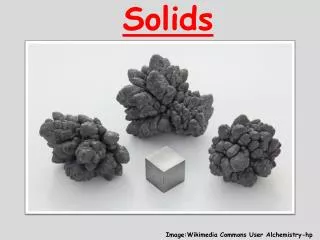
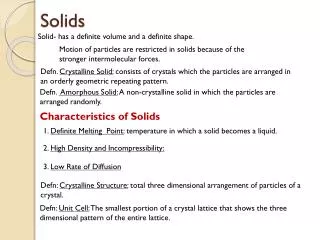
Properties of Solids 1. Definite shape, definite volume 2. Particles are CLOSE together 3. STRONG IM forces • Often highly ordered, • Rigid, incompressible ZnS, zinc sulfide
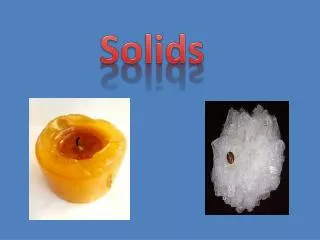
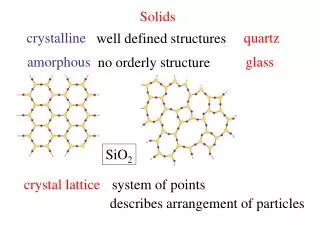
SOLIDS can be arranged into two categories: • Crystalline Solids: have a regular structure in which particles pack in a repeating pattern from one edge of the solid to another. • Amorphous Solids: “solids without form” have random structure and little long-range order. Includes glass and many plastics.
CRYSTALLINE SOLIDS • There are four types of crystalline solids • Classified on a basis of the bonding or attractive force holding them together • Molecular solids • Covalent network solids • Ionic solids • Metallic solids
1. Molecular Solids • Composed of atoms or molecules held together by IMF’s • Relatively soft, low mp’s, bp’s, etc. • Water, carbon dioxide, NH3, Iodine (I2), sugar (C12H22O11), and polyethylene are typical examples. • Example: Dry ice (CO2) sublimes at -78oC. • Strong intramolecular (covalent) bonds • O==C==O • Weak intermolecular forces - London • O==C==O • - + - • Symmetric molecule, nonpolar
Molecular Solids (cont.): • Example: Polyethylene • (-CH2-CH2-)n • Polyvinyl chloride (PVC) • (-CH2-CHCl-)n • or • H Cl H Cl H Cl • | | | | | | • ....C---C---C---C---C---C.... • | | | | | | NONPOLAR • H H H H H H London Forces
2. COVALENT SOLIDS • Form crystals that can be viewed as a single “giant” molecule held togetherby an endless number of covalent bonds. • Diamond is an example of a covalent solid. Diamond is hard and difficult to melt (mp = 3,550oC) because all bonds are equally strong. Also graphite, quartz, and asbestos.
Diamond Graphite
3. IONIC SOLIDS • Are held together primarily by the strong force of attraction between oppositely charged ions (ionic bonds) • Are typically hard, brittle, and nonconducting • High mp’s and bp’s • NaCl and CsF are typical examples. • Note: the strength of the bond depends on the radii of the formative ions. That is, the bond becomes weaker as the ions become larger or the ratio changes away from 1:1
Common Ionic Solids • Zinc sulfide, ZnS • The S2- ions are in TETRAHEDRAL holes in the Zn2+ FCC lattice. • This gives 4 net Zn2+ ions and 4 net S2- ions.
4. METALLIC SOLIDS • Malleable and ductile • Held together by “metallic bonds” • Have their valence electrons delocalized over many metal atoms. For this reason most metals are good conductors. • “sea of electrons” model • Jello with fruit • Includes Au, Fe, Al, etc.
4. METALLIC SOLIDS Atom “core” e- e- e- e- e- e- e- e- e- e- Delocalized valence electrons (move around)
Types of Crysatalline Solids TYPE EXAMPLE FORCE 1. Molecular Ice, I2 Dipole London 2. Network Diamond Extended Graphite covalent 3. Ionic NaCl, CaF2, ZnS Ion-ion 4. Metallic Na, Fe Metallic
Amorphous Solids • No regular geometric pattern • More “jumbled up” • Typically long chains of molecules that get tangled up together • Classified on a basis of the bonding or attractive force holding them together • Held together by IMF’s • Examples: waxes, asphalt, many plastics