Solids
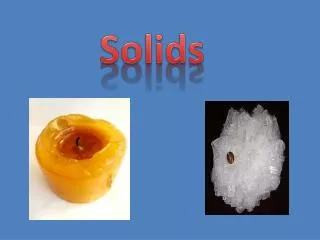
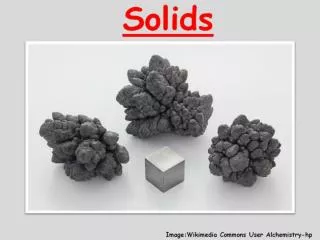
Solids. Image:Wikimedia Commons User Alchemistry -hp. Types of Solids. Crystalline Solids: highly regular arrangement of their components. Amorphous solids: considerable disorder in their structures (glass, plastic). Representation of Components in a Crystalline Solid.

Solids
E N D
Presentation Transcript
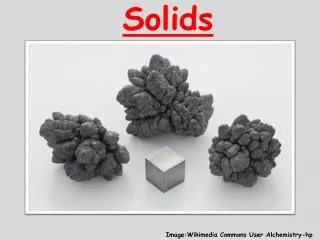
Solids Image:Wikimedia Commons User Alchemistry-hp
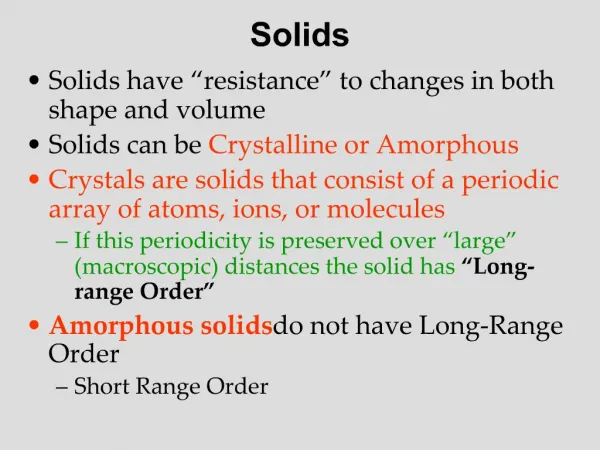
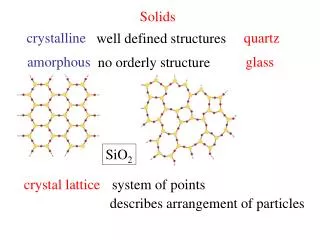
Types of Solids • Crystalline Solids:highly regular arrangement of their components • Amorphous solids: considerable disorder in their structures (glass, plastic).
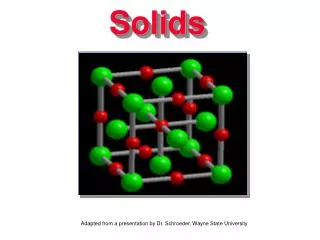
Representation of Components in a Crystalline Solid Lattice: A 3-dimensional system of points designating the centers of components (atoms, ions, or molecules) that make up the substance.
Bragg’s Law xy + yz = n and xy + yz = 2d sin n = 2d sin
Crystal Structures - Cubic Face-Centered Simple Body-Centered
Crystal Structures - Monoclinic Simple End Face-Centered
Crystal Structures - Tetragonal Body-Centered Simple
Crystal Structures - Orthorhombic Simple End Face-Centered Body Centered Face Centered
Crystal Structures – Other Shapes Rhombohedral Hexagonal Triclinic
Closest Packing: Single Layer Photographer : Thierry Dugnolle
Closest Packing: MultipleLayers Model: Packing uniform, hard spheres to best use available space. This is called closest packing. Each atom has 12 nearest neighbors.
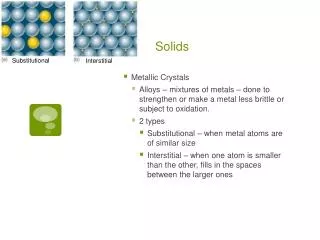
Metal Alloys • Substitutional Alloy: some metal atoms replaced by others of similar size. • brass = Cu/Zn
Metal Alloys(continued) • Interstitial Alloy: Interstices (holes) in closest packed metal structure are occupied by small atoms. • steel = iron + carbon
Network Atomic Solids Some covalently bonded substances DO NOT form discrete molecules. Diamond, a network of covalently bonded carbon atoms Graphite, a network of covalently bonded carbon atoms
Molecular Solids Strong covalent forces within molecules Weak covalent forces between molecules Sulfur, S8 Phosphorus, P4