Download
1 / 5
50 likes | 181 Views
This overview highlights significant terms and policies shaping U.S. foreign relations during Dwight D. Eisenhower's presidency. Key concepts include the Armistice between North and South Korea, the Eisenhower Doctrine aimed at countering Communism in the Middle East, and the strategy of Massive Retaliation through nuclear capabilities. It also explores ideas like Peaceful Coexistence and the impact of organizations such as S.E.A.T.O. and O.A.S. on Cold War dynamics, emphasizing the U.S.'s position against the U.S.S.R. and support for Third World nations.

E N D
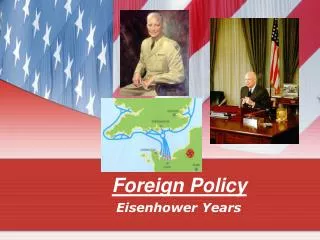
Foreign Policy Eisenhower Years
I. Terms 1. Armistice- -Truce between Nations 2. Brainwashing- -Forceful change of a person’s political views 3. Peaceful Coexistence- -Belief the U.S.A & U.S.S.R could have a peaceful relationship 4. S.E.A.T.O.- -South-east Asia Treaty Org. 5. Massive Retaliation- -Use of nuclear weapons
I. Terms continued… 6. Third World- -”Less-developed” Nations Non-world powers 7. Eisenhower Doctrine- -Plan to help Middle Eastern Nations resist Communism 8. O.A.S.- -Organization of American States
II. New Approaches to the Cold War 1. Korean Armistice: (1953) a. 38th Parallel -Divide N & S Korea 2. Dulles Policies: a. Arms Race -Compete with U.S.S.R. for military superiority -Increase Nuclear capabilities -”Balance of Terror” -”Mutual Assured Destruction”
III. Cold War Mechanics U.S.A. V. U.S.S.R. Democracy V. Communist “Support” (control) 3rd World Nations Greece Korea Viet Nam