Download
1 / 13
130 likes | 237 Views
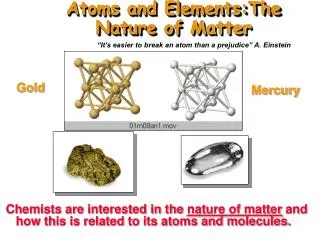
What’s the MATTER , part I. Matter:. Anything that has mass and takes up space Matter is made up of building blocks: atom – smallest unit of an element. element – a pure substance made of only one kind of atom. compound – made of two or more atoms that are chemically combined.

E N D
Matter: • Anything that has mass and takes up space Matter is made up of building blocks: atom – smallest unit of an element. element – a pure substance made of only one kind of atom. compound – made of two or more atoms that are chemically combined.
States of Matter • Solid- • Definite volume and shape • Particles are tightly packed • Slight expansion when heated • Incompressible
Liquid- • Has definite volume, but no definite shape (assumes the shape of the container) • Particles are loosely packed (can flow) • Easily expand when heated • Considered incompressible
Gas- • No definite shape or volume • Expands to fill the container • Particles are spaced far apart • Compressible
Plasma- • Consists of electrically charged particles • It’s an ionized gas • Common in space, but very rare on Earth • Found in lightning, fluorescent lights and neon signs
Gas Liquid Solid Plasma
Energy Amounts in States of Matter • Solid- little energy, particles vibrate and rotate • Liquid- more energy, they move freely • Gas- even more energy, move quickly • Plasma- most energy, move extremely fast
Names of Phase Changes • Solid to Liquid = Melting • Liquid to Gas = Boiling/evaporation • Gas to Liquid = Condensation • Liquid to Solid = Freezing • Solid to Gas = Sublimation • Gas to Solid = Deposition
States of Matter a.k.a. Phases of Matter Gas Energy Liquid Solid
Properties of Matter • 2 Types: • Extensive – depends on the amount of the sample (E AM IS) • Examples = volume mass length weight
Properties of Matter (cont.) • Intensive – does not depend on the amount of the sample (I AM NOT) • Examples = density melting point boiling point malleability ductility color odor