Download
1 / 9
90 likes | 220 Views
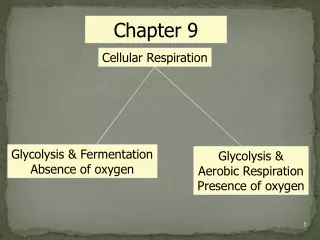
Cellular respiration is the process by which all cells convert glucose into ATP (adenosine triphosphate) using oxygen. This energy molecule is vital for various cellular activities as energy is stored in chemical bonds and released when ATP is broken down into ADP. The process consists of glycolysis, which occurs in the cytoplasm, followed by the Krebs cycle and the electron transport chain in the mitochondria. Together, these processes efficiently generate ATP, with up to 36 molecules produced from one glucose molecule, while releasing carbon dioxide and water as byproducts.

E N D
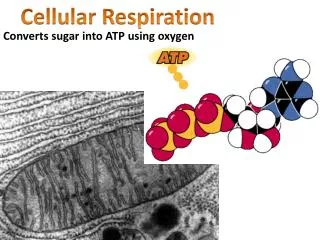
Cellular Respiration Converts sugar into ATP using oxygen
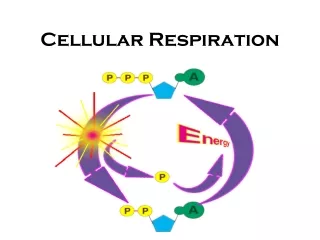
ATP = Adenosine Triphosphate Adenosine P P P • What is it? • Energy molecule • How store energy? • Energy stored in chemical bonds • Energy is released when ATP is broken into ADP • Why needed? • ATP used for cellular activities • ATP recreated when ADP + P rejoined Adenosine P P P Energy (heat)
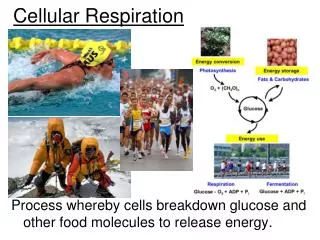
Cellular Respiration • Who: All cells • Purpose: Break food into useable molecules to create ATP • 1 glucose = 36/38 ATP (carbs = preferred source) • Exothermic reaction: reaction that releases heat
Step 1: Glycolysis • In cytoplasm of cell • Anaerobic process (does not require oxygen) • What happens? • Glucose (from our food) is broken down • How it happens? • 2 ATP split glucose into 2 three-carbon molecules called pyruvate • 2 ATP molecules released for use by the cell • Pyruvate enters mitochondria
Step 1: Glycolysis Mitochondria C ADP • In cytoplasm • What happens? • Glucose (from our food) is broken down • 2 ATP molecules released for use by the cell • Broken pieces of glucose enter mitochondria ADP C P ATP ATP C C glucose P C P ADP C P ADP P ADP ADP P P
1 ATP mitochondrion matrix (area enclosed by inner membrane) and 6CO 2 energy 2 3 energy from glycolysis ATP inner membrane and and 6H O 6O 2 2 4 Cellular respiration is like a mirror image of photosynthesis • The Krebs cycle transfers energy to an electron transport chain: • takes place inmitochondrial matrix • breaks down pyruvatemolecules from glycolysis • makes a small amount of ATP • releases carbon dioxide • transfers energy-carrying molecules to the electon transport chain Krebs Cycle
1 ATP mitochondrion matrix (area enclosed by inner membrane) and 6CO 2 energy 2 Electron Transport 3 energy from glycolysis ATP inner membrane and and 6H O 6O 2 2 4 • The electron transport chain produces a large amount of ATP. • takes place in inner membrane • energy transferred to electron transport chain • oxygen enters process • ATP produced • water released as awaste product
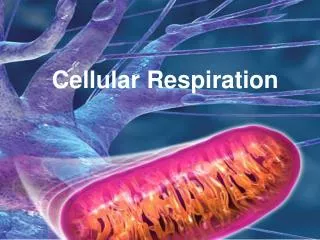
Step 2: Aerobic Respiration Mitochondria P ADP C ADP O2 C P • In mitochondria • Two separate processes: Kreb’s cycle & Electron Transport Chain • Mitochondria takes in oxygen • Oxygen bonds the ADP + P into ATP (up to 36 ATP’s) • CO2 waste created C O2 O2 P ADP ATP P C CO2 O2 ATP P CO2 C O2 O2 ADP ATP CO2 C ADP ADP P
REview • Which molecule is the energy molecule of cells? • Which types of organisms perform cellular respiration? • What is the chemical equation of cellular respiration? • Where does glycolysis occur? • What is broken down in glycolysis? • What is created by glycolysis? • Where is aerobic respiration performed? • Name the 2 subcategories of aerobic respiration. • What is the point on aerobic respiration? • Which waste is created by aerobic respiration?