Cellular Respiration
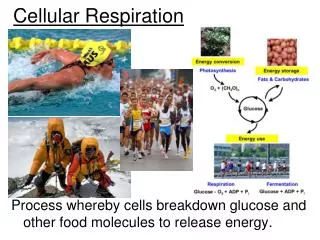
Cellular respiration is the biochemical process that converts glucose and food molecules into energy through aerobic and anaerobic pathways. This process begins with glycolysis, which breaks down glucose into pyruvic acid, yielding ATP and NADH. When oxygen is present, pyruvic acid undergoes the Krebs Cycle, producing carbon dioxide and additional energy carriers. In the absence of oxygen, fermentation occurs, resulting in lactic acid or ethanol and carbon dioxide. Understanding these mechanisms is crucial for comprehending energy utilization in exercise and metabolism.

Cellular Respiration
E N D
Presentation Transcript
Chemical Energy and Food • A Calorie (with a capital C) is the amount of energy required to raise the temperature of 1 gram of water by 1 degree Celsius. • Note: The calorie you see on a cereal box is actually a kilocalorie or 1,000 Calories. • 1 Calorie = 4,184 joules
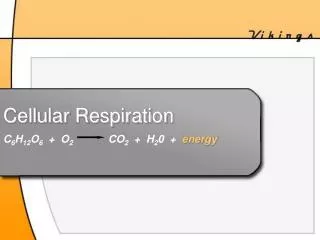
Cellular Respiration • Cellular Respiration is the process that releases energy by breaking down glucose and other food molecules in the presence of oxygen. • Cellular Respiration Equation: • 6O2 + C6H12O6 6CO2 + 6H2O + Energy
Glycolysis • First part of cellular respiration: Glycolysis. • Glycolysis is the process in which one molecule of glucose is broken in half, producing two molecules of pyruvic acid (a 3-carbon compound) • 2 ATP molecules are needed go into glycolysis • The cell uses those two ATP and makes 4 ATP molecules and 2 NADH molecules • Therefore, a net gain of 2 ATP and 2 NADH
No oxygen? No problem… sort of • When oxygen is not present, glycolysis is followed by fermentation. • Fermentation releases energy from food molecules by producing ATP in the absence of oxygen • Fermentation is anaerobic – does not require oxygen. • Two main types: • Lactic acid fermentation • Alcoholic fermentation
Alcoholic Fermentation • Yeast uses alcoholic fermentation, forming ethyl alcohol and carbon dioxide as wastes • Pyruvic acid + NADH alcohol + CO2 + NAD+ • This process makes bread rise and of course alcohol
Lactic Acid Fermentation • Lactic acid can be made from pyruvic acid in the absence of oxygen • This occurs in your muscles during rapid exercise when you’re not getting enough oxygen to your cells • Pyruvic acid + NADH Lactic acid + NAD+ • Lactic acid build up is painful = pain in muscles while working out
Lactic Acid Fermentation • Unicellular organisms going through lactic acid fermentation are used to make cheese, yogurt, buttermilk, and sour cream.
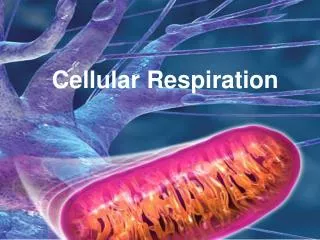
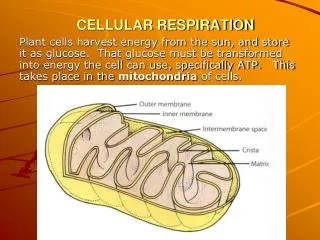
The Krebs Cycle • In the presence of oxygen (aerobic), after glycolysis, pyruvic acid goes to the Krebs Cycle (also called the Citric Acid Cycle). • During the Krebs Cycle, pyruvic acid is broken down into carbon dioxide and energy is extracted • Step 1: Pyruvic acid enters mitochondria. One carbon is wasted as carbon dioxide. Two carbons become acetyl-CoA and forms citric acid.
The Krebs Cycle • Step 2: The citric acid is broken down, more carbon dioxide is released, and electrons are transferred to electron carriers. • This carbon dioxide that is released is what you breathe out. • NAD+ and FAD (flavine adenine dinucleotide) are the electron carriers. They are converted into NADH and FADH2.
Electron Transport • Electrons from the Krebs Cycle are passed from NADH and FADH2 to the electron transport chain (ETC). • The ETC uses these electrons from the Krebs cycle to convert ADP into ATP. • Step 1: Electrons passed through carrier proteins located on membrane of mitochondria (eukaryotes) or cell membrane (prokaryotes). • Oxygen is the final electron acceptor and combines with H+ to form water.
Electron Transport • Step 2: Every time 2 electrons move down the chain, H + is moved across the membrane. • These H + ions make the membrane positive • Step 3: As the H + ions move across the membrane, ATP synthase attaches a phosphate group to ADP making ATP.
Totals of Cellular Respiration • 36 total ATP produced in presence of oxygen
Energy and Exercise • Exercise that is intense and ends quickly will utilize fermentation. • Example: 200 m dash • Body only has enough ATP for a few minutes of intense activity • Exercise that is long-lasted and steady will use cellular respiration. • Example: aerobic exercises like swimming, running, dancing. • Cell respiration generates a continuous, steady supply