### Enhancements in Trigger Processor for NSW Detector: Level-1 Synchronization and Geometry Integration ###
This document outlines the requirements and enhancements for the Trigger Processor (TP) of the NSW detector, specifically focusing on Level-1 trigger synchronization and output management. It details design parameters such as incidence angle resolution (

### Enhancements in Trigger Processor for NSW Detector: Level-1 Synchronization and Geometry Integration ###
E N D
Presentation Transcript
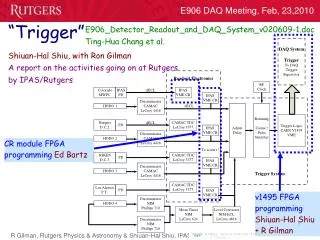
Trigger processor John Huth Harvard
NSW + TGC of BW’s Small Wheel TGC1 TGC2 TGC3 m • Precision Detector • < 100mm • f-information • Level-1 Triggerresolution of incidence angle • < 1 mrad • BCID, LVL1 latency b 2/3 coin. hit position 3/4 coin. track position and deviation Phase-1 upgrade H-pT Board track fitting track position (R, f) dq : deviation of incidence angle from infinite pT muons Coarse dq -cut RoI, dR, df Sector Logic R-f coin. track fitting crossing angle : b pT calculation hit information (R, f) , dq
Matching between BW sector and NSW, bit format NSW coverage : h = 1.3 – 2.4 # of RoI’s in Large SW Sector : 560 # of RoI’s in Small SW Sector : 366 Position info. f/h : 0.02-0.03precision (RoI size) b calculation : need h ~ 0.01 # of granularities per SW Sector < 1024 # of bits per track is 16-bit Position : 10-bit dq : 5-bit, 1mrad resolution hit flag : 1-bit Total: 16-bit # of tracks per fibre @ 40MHz 4 tracks @ 40 MHz (16+4)-bit x 4 x 40MHz = 3.2 Gbps Max. # of tracks per Large SW Sector up to 8 or 12 tracks, 2 or 3 fibres Max. # of tracks per Small SW Sector up to 4 or 8 tracks, 1 or 2 fibres NSW boundary BW boundary
Rendezvous at 44 ticks in the front of SL 444444 44 New SL : 10 ticks
Requirements to Trigger Processor of NSW detector • Outputs to Sector Logic should be fully synchronous to 40 MHz clock. • Packets in every clock contain a complete set of track info. of each bunch, independent of each other. • Fixed latency • No queuing structure at Sector Logic • 3 fibres for Large SW Sector • 2 fibres for Small SW Sector • NSW detectors should combine track info’s from sTGC and MicroMegas. Do not deliver them separately. • Latency to Sector Logic is shorter than 44 clk’s. • New Sector Logic incorporate segments info. from BIS7,8, EES and EEL into the level-1 trigger decision.
Assumptions about number of bits required for spatial information [F/B][L/S] [Wedge] [Plane] [Strip] 1 + 1 + 4 + 4 + 14 = 24 bits Need BCID – integrate over four crossings
Full use of trigonometric functions Early results with old geometry (will show updated geometry)
Current XUV Geometry Random background, radial fall-off
Personnel at Harvard • J. Huth • D. Lopez Mateos • B. Clark • N. Felt (EE) • J. Oliver (EE)
To do list (short term): • Implementing new geometry (XUV) • Background • BCID integration • Algorithm exploration • FPGA function exploration+timing • Examine stereo orientations in Z • Begin use of Athena when digitization is fully implemented