The Cold War
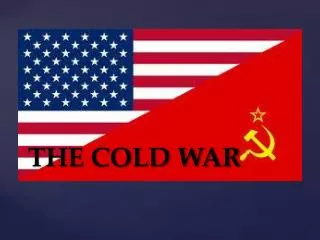
Explore the complex origins of the Cold War, focusing on the factors that fueled Soviet distrust of the West. From the 1919 Allied support for White Russians during the Civil War to the absence of the Soviet Union in the Treaty of Versailles, this analysis delves into key events such as the delayed US entry into WWII and the sudden cessation of aid. Discover how the Communist Revolution, the Soviet-Nazi Pact, and the impact of the Iron Curtain shaped post-war Europe. Key policies like the Truman Doctrine and the Marshall Plan further solidified the divide, leading to global conflict.

The Cold War
E N D
Presentation Transcript
Why the Soviets Distrusted West • In 1919, Allies aid White Russians in Civil War • Soviet Union not apart of Treaty of Versailles • US delay in opening second front in WWII • US suddenly ends aid before WWII over. Columbia Encyclopedia
Why the West Distrusts the Soviets • Communist Revolution • Expansion of Communism • Soviet-Nazi Pact • Invasion of Poland • Conquest of Eastern Europe • Development of Soviet A-Bomb 1949 Hitler Stalin
The Iron Curtain • As early as 1946, Winston Churchill saw what was happening. “An Iron Curtain has descended upon Europe” • Churchill’s Speech: http://www.youtube.com/watch?v=S2PUIQpAEAQ • PBS.org
Policies of the Cold War in Europe • Containment • Truman Doctrine, 1947 • Marshall Plan, 1947 • Berlin Blockade and Airlift, 1948-49
Cold War Goes Global • Chinese Revolution, 1949 • Cuban Revolution, 1960 • Nonaligned Movement • India Mao Zedong
Pillars of Cold War: Containment • Military Alliances • NATO • SEATO • Economic Aid • Korean War, 1950-53 • Vietnam War, 1954-75
Pillars of the Cold War: Deterrence • Nuclear Triad • MAD
Pillars of the Cold War: Covert Ops • Resist wars of National Liberation • Assassination • Europe elections • Iran 1953 • Guatemala 1954 • Chile 1973 Chilean troops engage in mass arrests during the coup of 1973