
Understanding Population Dynamics and Public Health: HIV/AIDS and Global Demographics
This homework assignment examines critical topics in population dynamics, with a specific focus on HIV/AIDS and its impacts on society. Starting with population structure and transitioning to public health issues, students will analyze the correlation between poverty, education, and population growth. Key vocabulary words and demographic concepts will provide a deeper understanding of how these factors interrelate, particularly in developing nations like Uganda, where HIV/AIDS poses a significant challenge. Key questions will guide critical thinking and discussion.

Understanding Population Dynamics and Public Health: HIV/AIDS and Global Demographics
E N D
Presentation Transcript
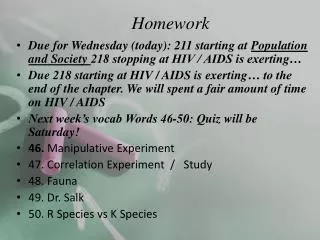
Homework • Due for Wednesday (today): 211 starting at Population and Society 218 stopping at HIV / AIDS is exerting… • Due 218 starting at HIV / AIDS is exerting… to the end of the chapter. We will spent a fair amount of time on HIV / AIDS • Next week’s vocab Words 46-50: Quiz will be Saturday! • 46. Manipulative Experiment • 47. Correlation Experiment / Study • 48. Fauna • 49. Dr. Salk • 50. R Species vs K Species
Do now • What is the connection between the Destiny Africa group and the topics we are discussing? Hint, where was the group from and what is the greatest issue in that region? • Group is from Uganda • The area is ground zero for HIV / AIDS
Quick Review • What is IPAT? • Impact = Population x Affluence x Technology, sometimes add S for sensitivity, meaning development in a sensitive area. • Strong nations tend to have slow population growth. Why? • Demography? What is it?
Population distribution • Humans are unevenly distributed around the globe • Unpopulated areas tend to be environmentally sensitive (high S value in the IPAT equation) • Vulnerable to humans (e.g., deserts, arid grasslands)
Age structure affects population size • Age structure diagrams (population pyramids) show age structure • Wide base = many young: • High reproduction • Rapid population growth • Even age distribution: • Remains stable • Births = deaths
Age structures: Canada vs. Madagascar Madagascar’s age structure is heavily weighted toward the young Canada’s age structure is balanced
New Material • Transition Demographics – explain the chart below
Reading to focus on • Why did Fertility Decline in Bangladesh decline? • Education of women: • Better opportunities • Greater chance of not living in poverty • Longer lives • Educating women reduces fertility rates, delays childbirth, and gives them a voice in reproductive decisions
Empowering women reduces growth rates • Fertility rates drop when women gain access to contraceptives, family planning programs, and educational opportunities • Women with little power have unintended pregnancies • Two-thirds of the world’s illiterate are women
Correlation of poverty and population • Poverty exacerbates population growth • Population growth exacerbates poverty • In 1960, 70% of all people lived in developing nations • As of 2010, 82% live in these nations • 99% of the next billion will be born in these nations
Poverty & environmental degradation • Population growth in poor nations increases environmental degradation • Farming degrades soil in arid areas (Africa, China) • Poor people cut forests, deplete biodiversity, and hunt endangered species (e.g., great apes) Africa’s Sahel and western China are turning to desert
Question • In the industrialized world, what is the greatest cause of death? • Heart Disease – directly related to poor diets (obesity). • What about in the 3rd World? • AIDS, why? • Is AIDS really an issue in the United States?