Acid- Base Reactions
This informative chapter delves into the characteristics of acids and bases, highlighting their physical traits such as taste (sour for acids, bitter and slippery for bases), pH levels, and classifications via the Arrhenius, Brønsted-Lowry, and Lewis definitions. It explores the net ionic equations for strong and weak acids and bases, emphasizing the differences in dissociation. Practical examples illustrate the stoichiometry of acid-base reactions, showing how to calculate reactant volumes and moles, ensuring a solid understanding of these fundamental chemical concepts.

Acid- Base Reactions
E N D
Presentation Transcript
Acid- Base Reactions Chapter 4 part IV
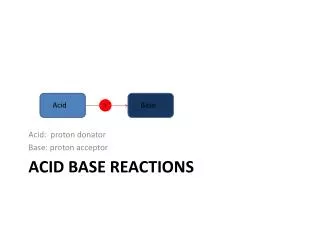
Characteristics of acids • Sour • Red litmus test • Low pH <7 • Arrhenius: Produce H+ in water. • Brømsted Lowry: produce protons. • Lewis: Electron acceptor.
Characteristics of bases • Slippery & bitter • Blue litmus test • High pH >7 • Arrhenius: forms OH- in water. • Brømsted Lowry: accept protons. • Lewis: Electron donor.
Net Ionic Equation • Of all strong acids plus strong bases: • H+ + OH- H2O • But what about weak acids and bases? • In a strong acid or base, it dissociates completely in water (strong electrolyte) • Weak acids and bases do not dissociate completely in water
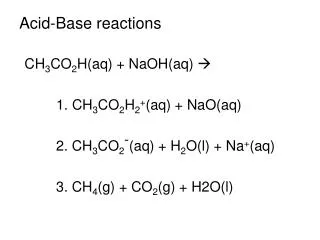
Weak electrolytes • In fact about 90% of acetic acid remains intact in aqueous solution. • Therefore the net ionic equation of a weak acid or base includes the intact weak acid or base. • Example: HC2H3O2 +Na++ OH- H2O+ C2H3O2- +Na+ Net Ionic: HC2H3O2 + OH- H2O + C2H3O2-
Weak electrolytes • An example of a weak base is NH3. • So what is the net ionic equation for hydrochloric acid and ammonia? • HCl + NH3 NH4+ + Cl- • H+ + Cl- + NH3 NH4+ + Cl- • H+ + NH3 NH4+
Stoichiometry of an acid/base reaction: The steps. • List species present in the combined solution, before any reaction occurs. • Decide what reaction will occur. • Write out net ionic equation. • Calculate moles of reactant in solution. Use volume of the original solution and its molarity. • Determine the Limiting reagent.
Stoichiometry of an acid/base reaction: The steps. • Calculate the moles of required reactant or product formed. • Convert to grams or volume as required. • In other words, after you answer the question, reread the question and make sure.
Example: • What volume of 0.1 M HCl solution is needed to neutralize 25.0 mL of 0.350 M NaOH?
Answer • List the species: H+ Cl- Na+ OH- • What are the possible products? • NaCl (s) And H2O (l) • NaCl is soluble therefore it is not a possible product in solution. • Write the balanced equation. • H+(aq) + OH-(aq) H2O(l)
Answer • Calculate moles of reactants: • OH- = 25 mL NaOH x (1L/1000mL)x (0.350 mol OH-/L NaOH) = • 8.75 x10⁻³ mol OH- • No limiting reagent, finding volume of HCl • Moles of reactant needed: molar ration is 1:1 therefore need 8.75 x 10⁻³ mols acid. • Convert to volume: V x M=mol
Therefore • V x 0.100 mol H+ /L = 8.75 x 10⁻³ mol H+ • V= 8.75 X 10⁻² L