Download
1 / 10
110 likes | 358 Views
This text explores fundamental concepts of redox (oxidation-reduction) reactions in chemistry, focusing on electron transfer during acid-base reactions, including thermite and oxidation examples. It details the oxidation states of elements such as iron and aluminum, illustrating key rules for assigning oxidation numbers. The significance of electron gain and loss in these reactions is examined, along with practical examples, such as the reactions of metal oxides and the properties of monatomic ions. This resource is ideal for students looking to deepen their understanding of redox processes.

E N D
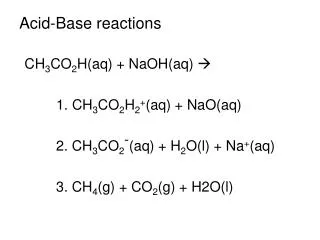
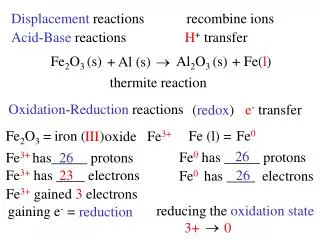
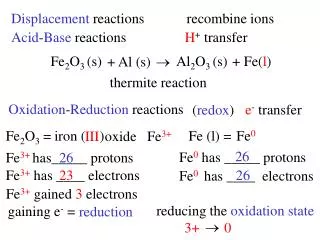
Displacement reactions recombine ions Acid-Base reactions H+ transfer Fe2O3 (s) Al2O3 (s) + Fe (l) + Al (s) thermite reaction Oxidation-Reduction reactions e- transfer (redox) Fe2O3 = iron ( ) Fe (l) = Fe0 III oxide Fe3+ 26 Fe0 has _____ protons Fe3+ has_____ protons 26 Fe3+ has ____ electrons 23 26 Fe0 has ____ electrons Fe3+ gained 3 electrons reducing the oxidation state gaining e- = reduction 3+ 0
Fe2O3 (s) Al2O3 (s) + Fe (l) + Al (s) Al2O3 aluminum oxide Al (s) = Al0 Al0has _____ electrons 10 13 Al3+has ______ electrons 3+ oxidation state = 0 oxidation state = Al0 loses___ e- 3 losing e- = oxidation increase oxidation number 3+ 0 LEO GER Lose Electrons Oxidation Gain Electrons Reduction
Rules for oxidation numbers 1. Oxidation number for elements is zero. N2, O2, Na(s), Co(s), He (g) • Oxidation number of monatomic ions • is the same as their charge Group IA = +1 Al3+, Zn2+, Cd2+, Ag+ Group IIA = +2 • Oxidation number of oxygen in most compounds • is –2. Exceptions: H2O2, O2- (peroxides) –1 4. Oxidation number of hydrogen is +1 Exceptions: bonded to metals LiH 5. Fluorine is always –1. Other halogens are –1. Exceptions: bonded to O, they are positive
Assign oxidation numbers to all of the elements: Li2O Li = +1 O = -2 PF3 P = +3 F = -1 HNO3 H = +1 +5 O = -2 N = MnO4- Mn = +7 O = -2 Cr2O72- Cr = +6 -2 O =
What is the oxidation state of the highlighted element? P2O5 +5 diphosphorous pentoxide NaH -1 sodium hydride SnBr4 +4 tin (IV) bromide BaO2 -1 barium peroxide
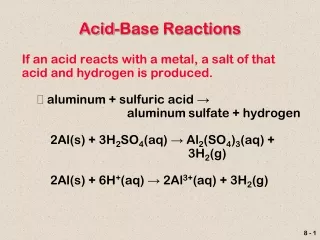
Redox reactions 0 +1 0 +2 H2 (g) + 2H+ (aq) + Zn Zn (s) 2+ Zn oxidation state 0 +2 increase lose electrons oxidized reducing agent H oxidation state +1 0 decrease gain electrons reduced oxidizing agent
0 0 +1 -2 + O2 (g) 2H2O(l) 2H2(g) H loses or gains electrons is oxidized or reduced oxidizing or reducing agent O loses or gains electrons is oxidized or reduced oxidizing or reducing agent
0 +7 +3 +4 + Al(s) + MnO4- Al(OH)4- + MnO2 2H2O H2O What is being oxidized? Al What is oxidation? MnO4- Al(OH)4- LEO MnO2 How many e-? What is being reduced? GER What is the reducing agent?
What is the oxidation state of S in each of these compounds: H2S H = S = -2 +1 S8 S = 0 SCl2 S = +2 -1 Cl = Na2SO3 S = +4 O = -2 Na = +1 SO42- S = +6 -2 O = Which of these compounds can not act as a reducing agent? Which of these compounds can not act as a oxidizing agent?
+1 0 +4 -2 +1 -2 +2 -2 +2 -2 +1 Cd(OH)2 + Ni(OH)2 + NiO2 + 2H2O Cd(s) What is being oxidized? What is being reduced? What is the oxidizing agent? What is the reducing agent? How many electrons are transferred?