Download
1 / 14
140 likes | 355 Views
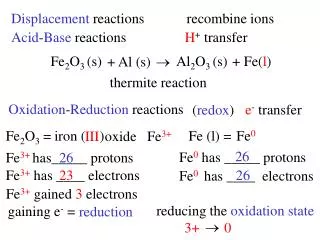
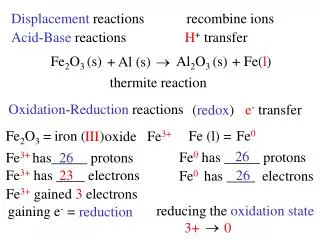
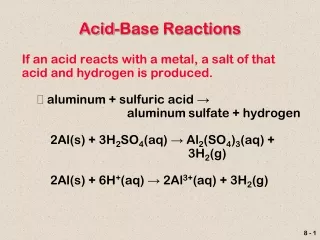
This document explores the fundamentals of acid-base reactions and the solubility of various ionic compounds. It includes specific examples of reactions such as the interaction between acetic acid (CH3CO2H) and sodium hydroxide (NaOH), as well as the behavior of weak acids and their conjugate bases. The concept of solubility is addressed, highlighting the importance of understanding soluble and insoluble compounds through precipitation reactions. Additionally, net ionic equations are provided to illustrate gas-forming reactions, enhancing comprehension of acid-base dynamics.

E N D
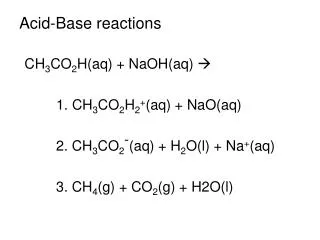
Acid-Base reactions CH3CO2H(aq) + NaOH(aq) 1. CH3CO2H2+(aq) + NaO(aq) 2. CH3CO2-(aq) + H2O(l) + Na+(aq) 3. CH4(g) + CO2(g) + H2O(l)
Acid-Base reactions HCN(aq) + NH3(aq) 1. NH4+(aq) + CN-(aq) 2. H2CN+(aq) + NH2-(aq) 3. C2N2(s) + 3 H2(g)
Acid-Base Reactions:Find the hidden bases Thing to know: Anions of weak acids are bases. Example: CH3COOH = weak acid CH3COO- therefore = weak base HCN = weak acid CN- = weak base H3PO4 = weak acid PO43- = weak base
Return to Acid-Base Reactions:Find the hidden bases HCl + NaCN ? HCl + AlPO4 ? HCl + CaC2O4 ?
Precipitation Reactions Solubility of Ionic Compounds dissolving
To Determine Solubility: 1. identify the two ions 2. soluble ions with no “exceptions” never form precipitates 3. use listing under soluble/insoluble, but check to see if it’s an exception
Examples Soluble or Insoluble? • NaNO3 • FeCl3 • Fe(OH)3 • BaSO4 • AgNO3 • AgCl
More Examples Soluble or Insoluble? • K3PO4 • Fe3(PO4)2 • PbCl2 • FeSO4 • (NH4)2S • PbS
PRS Example 1 Which of the following is soluble? • AlPO4 • PbBr2 • Al(OH)3 • FeSO4
PRS Example 2 Which of the following is insoluble? • Al(NO3)3 • PbC2O4 • NaOH • FeF3
Precipitation ReactionsNet Ionic Equations Pb(NO3)2 + K2CrO4 ? Pb(NO3)2 + KI ? BaCl2 + KNO3
Gas Forming Reactions 2 H+ + CO32- CO2(g) + H2O(l) 2 H+ + SO32- SO2(g) + H2O(l) 2 H+ + M H2(g) + M2+(aq) M = metal, like Mg or Fe