Enhancing Communication Skills: The Art of Sending and Receiving Messages
Effective communication is essential for meaningful interactions. It involves sending a message from a transmitter to a receiver, who must understand it accurately. Communication can be verbal—through speaking, writing, or texting—or non-verbal, using signs, symbols, body language, and facial expressions. A significant portion of communication is non-verbal, with research suggesting it comprises 65-80%. Misunderstandings can arise if messages are not interpreted correctly. To foster clarity, ask questions, be specific, and paraphrase. Remember, how you say something can matter as much as what you say.

Enhancing Communication Skills: The Art of Sending and Receiving Messages
E N D
Presentation Transcript
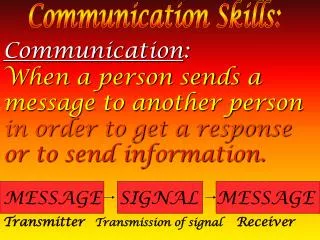
Communication Skills: Communication: When a person sends a message to another person in order to get a responseor to send information. MESSAGE SIGNAL MESSAGE Transmitter Transmission of signal Receiver
Effective Communication: When the receiver understands the message the transmitter sends. Verbal Communication: The use of words and language to communicate. Ex. Singing, speaking, (writing),(e-mail),(text message). Braille? Sign Language?
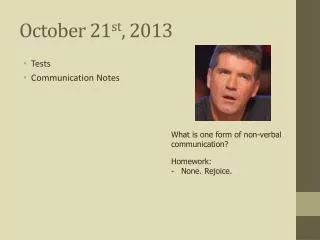
Non-Verbal Communication: The use of signs and symbols to communicate. Ex. Signs, appearance, facial expressions, body language. What % of communication is Non-Verbal? Peanut butter 65-80%
One-way Communication: A response. (can be verbal or nonverbal) Sending a message but not getting a response. Feedback: diagrams
Misunderstanding: When the receiver interprets the message differently than the sender intended.
Ways to avoid misunderstandings: • Ask Questions 2. Be Specific 3. Paraphrase – restate in your own words
Voice Inflection: GNH Lumber, Sophias Expressions: Afraid, Surprise, Bored The tone of voice used to get amessage across. “The way(how) you say something maybe more important than what you say.” Directions:
WW WW