Download
1 / 17
170 likes | 268 Views
The consequences of World War I on Russia: unprepared entry into war, mutiny among soldiers, dwindling supplies, regime corruption, March Revolution, Bolshevik Revolution, Lenin’s rise to power, Civil War, and chaos during the Russian Revolution. Comparisons made with the German Revolution and the unique case of the Spartacists.

E N D
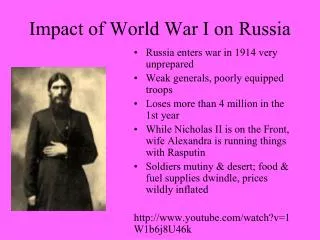
Impact of World War I on Russia • Russia enters war in 1914 very unprepared • Weak generals, poorly equipped troops • Loses more than 4 million in the 1st year • While Nicholas II is on the Front, wife Alexandra is running things with Rasputin • Soldiers mutiny & desert; food & fuel supplies dwindle, prices wildly inflated http://www.youtube.com/watch?v=1W1b6j8U46k
Rasputin & Alexandra • Czarina Alexandra controls daily operations during WWI • Under influence of Rasputin • Thought he could ‘cure’ Alexi’s hemophilia • Life in St. Petersburg becomes corrupt • Generates disgust & mistrust
March Revolution • Strikes flare up everywhere over shortages • Soldiers refuse orders to shoot the rioters • Czar Nicholas II forced to abdicate • Provisional Government created - Kerensky
First Soviets • Lenin – exiled radical returns • Underground radicals emerge to lead revolts • Radicals organize workers, peasants & soldiers into soviets • Believed that industrial workers would overthrow the Czar • After the revolution, the workers would rule: ‘dictatorship of the proletariat’
Bolsheviks favored revolution by a small number of committed revolutionaries • Other groups want less radical reform – like the mensheviks and Social Democrats
Lenin in Power • TREATY OF BREST –LITOVSK • LAND REFORM
Civil War in Russia CHEKA
A German Revolution Too? • Similar to Russia • Popular uprising from below • Brought down Ancien Régime • Established Liberal Provisional Government • Socialists take control of government • Workers & soldiers create alternative governments
Why is German Case Different? • Liberals & moderate socialists ally • They triumph over more radical forces in councils • German Marxists not as radical as Russian Marxists - more revisionist
German Social Democrats • Accepted defeat (unlike Kerensky) • Puts a stop to drop in soldier morale • Limited by status as defeated aggressor of WW1
Spartacists • Co founders: Karl Liebknecht & Rosa Luxemburg • Favored uprisings that would give workers political experience (vs. Russian Marxists) • Based in councils • Attempt to seize power crushed by Social Democrats with help of army • Murdered by army leaders- with support of Social Democrats