Download
1 / 27
270 likes | 370 Views
Explore the vibrant Harlem Renaissance era of the 1920s, a cultural movement that brought African American artists, writers, musicians, and thinkers together to challenge societal norms and demand recognition. Immerse yourself in the sounds, ideas, and stories that shaped a generation and inspired change in America. From the migration to Harlem to the evolution of art forms, witness the rich tapestry of expression that emerged during this transformative period. Discover the voices that refused to be silenced and made a lasting impact on American culture.

E N D
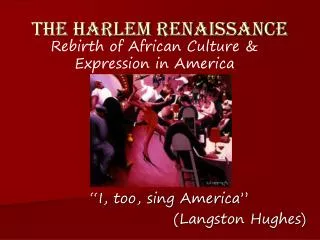
The Harlem Renaissance From poetry to Civil Rights…an evolution of sounds and ideas.
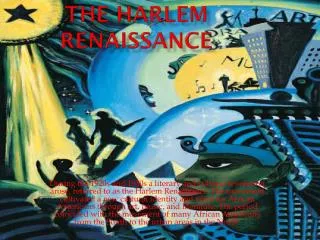
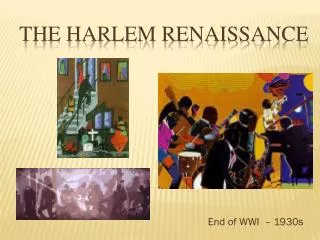
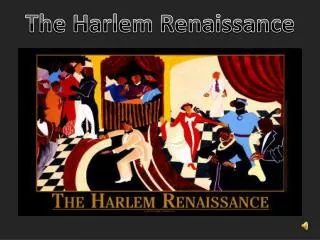
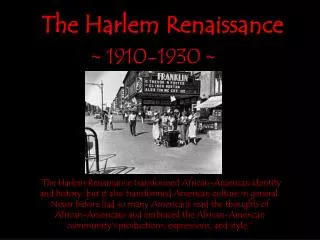
In the early 1920s, African American artists, writers, and performers were part of a great cultural movement known as the Harlem Renaissance.
Historical Connections • African American migration to the north • Doctors, singers, students, musicians, painters, writers, shopkeepers congregated in a neighborhood called Harlem • Forming a vibrant mecca of cultural inspiration • Demanded to be a part of American culture • Garnering a new respect from mainstream America
The African American Experience • Writers wrote about it… • Artists painted it… • Photographers recorded it… • Musicians put it to music • Vocalists sang about it… “It was the period when the Negro was in vogue.” --Langston Hughes
I hate to see de evenin’ sun go down. Hate to see de evenin’ sun go down, Cause my baby, she done lef dis town. ---W.C. Handy “St. Louis Blues”
I worry all day, I worry all night, Everytime my man comes home he want to fuss and fight, When I pick up the paper try to read the news, Just when I’m satisfied, yonder comes the blues. --Ma Rainey “Yonder Comes the Blues”
When you get good lovin’ never go and spread the news, When you get good lovin’ never go and spread the news, They’ll double-cross you and leave you with them empty bed blues. --Bessie Smith “Empty Bed Blues”
Rhetorical Modes • Autobiographies • Poetry • Short stories • Novels • folklore
Themes Issues of… • Race • Class • Religion • Gender • Relationships
A by-product of African American writing was the affirmation that black dialects were as legitimate as standard English.
I, Too I, too, sing America.
I am the darker brother. They send me to eat in the kitchen When company comes, But I laugh, And eat well, And grow strong.
Tomorrow, I’ll be at the table When company comes. Nobody’ll dare Say to me, “Eat in the kitchen,” Then.
Besides, They’ll see how beautiful I am And be ashamed—
All websites and images from this presentation were obtained from the Library of Congress American Memory Collection.