Download

1 / 5
50 likes | 165 Views
Explore the fundamental concepts of classical conditioning as discussed in Chapter 9. This chapter introduces three kinds of learning: classical (where a neutral stimulus elicits a response), operant (behavior changes due to consequences), and cognitive (involving mental processes). Key experiments, including Pavlov's Dog and the Little Albert study, illustrate concepts like unconditioned and conditioned responses, generalization, discrimination, extinction, and spontaneous recovery. Discover how these principles apply to real-life situations such as taste aversion, emotional responses, and therapeutic techniques like systematic desensitization.

E N D
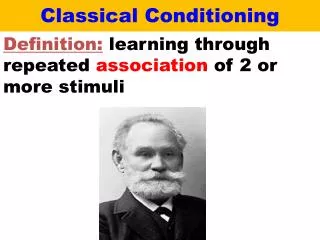
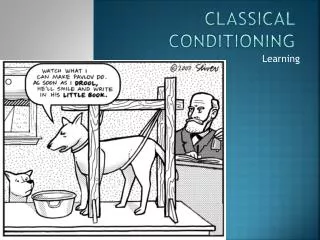
Classical Conditioning Chapter 9
Three Kinds of Learning • Classical – neutral stimulus produces a response from an original stimulus • Found in chapter 9 • Operant – consequences change behavioral occurrences • Cognitive – mental processes involving attention, memory, observation and imitation • Both found in chapter 10
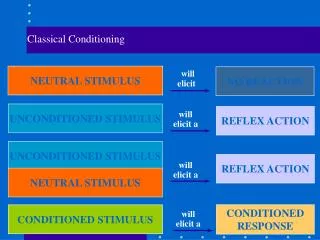
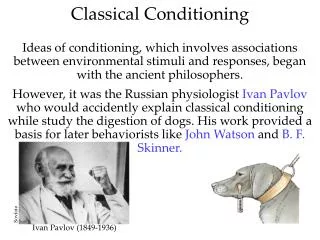
Classical Experiments • Pavlov’s Dog • Dentist, Needles, etc. • Little Albert • Unconditioned stimulus – natural • Neutral stimulus – no response • Unconditioned response – natural • Conditioned response – learned
Conditioning Concepts • Generalization – similar stimuli • Discrimination – different stimuli • Extinction – no longer responds • Spontaneous Recovery – response reappears • Adaptive value for survival • Taste-aversion for safety • Natural preparedness traits • Emotional responses
Classical Results Theories Applications Anticipatory Nausea Systematic Desensitization Mass Appeal/Suggestion • Stimulus Substitution • Contiguity Theory • Cognitive Perspective