Download
1 / 8
80 likes | 179 Views
Discover insights from the liberalization of long-distance bus services in Norway, analyzing growth, challenges, customer satisfaction, and market development over 15 years. Key findings, driving forces, and conclusions from the Institute of Transport Economics study are discussed.

E N D
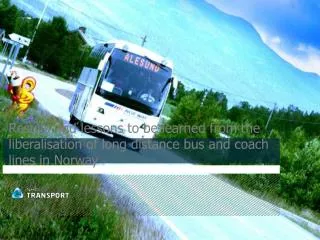
Results and lessons to be learned from the liberalisationof long distance bus and coach lines in Norway
High passenger growth in 15 years – some stagnation in the last 3 years
High costumer satisfaction over time- express bus scores higher then ordinary public transport
Development in Express bus market from 2000 Kilde: TØI
Conclusions from a new study from Institute of Transport Economics • Express bus industry has grown after liberalisation (1998-2003). Stagnation and small decline slightly from 2007/2008 • In general, the routes are commercially-driven.But there is an element of grant • Important services in rural areas when it is complementing the public transport offered by the county. • The express bus system gives favourable economic benefit for the society
Driving forces behind the successful development in the market • Innovative entrepreneurs who were willing to take risks • Creation of new routes • Establishment of new concepts • Cooperation with the county on routes • Express bus = local transport in area wit low population density • PTAs buy capacity (seats) for pupils • Liberalisation of the access to the market
What happened ? • Allowed to compete with the railway after the permission was given. • Full liberalisation in two steps • Free to compete with railway in eastern Norway • Free access to market in the whole country • Competitions from low cost airline, train and PTA taking over some lines 1
Conclusions • The bus industry can and will make new and attractive express bus services if the conditions are right • The market and competition functioning, it gives more passengers • between modes of transport • between different express bus services • Cooperation between PTA and exspressbuscompanies are important • Terminals and travel information • Rural areas