Download
1 / 22
220 likes | 337 Views
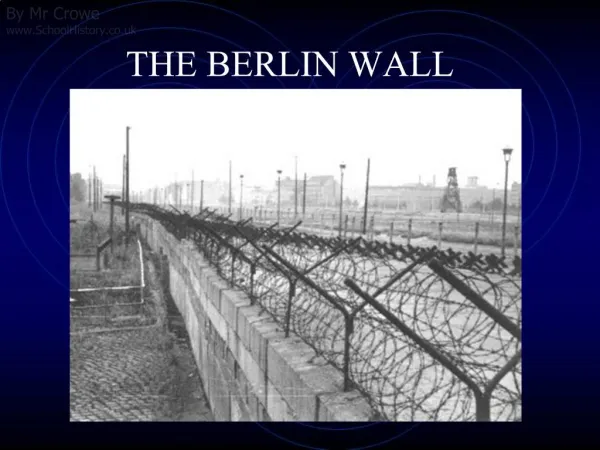
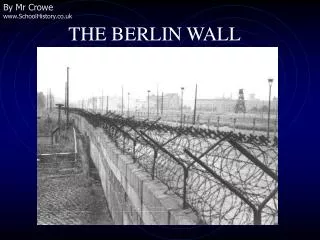
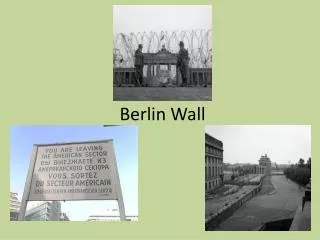
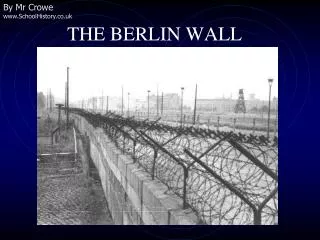
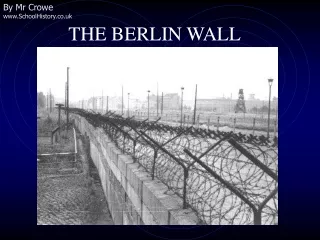
The Berlin Wall symbolized the division between the democratic West and the communist East during the Cold War. NATO, a mutual defense alliance of Western democracies, contrasted sharply with the Warsaw Pact of Eastern communist nations. The period saw significant tensions including the Korean War, the Vietnam War, and conflicts in the Middle East. The arms race and space race further exemplified the competition between the superpowers. This article explores the dynamics of military alliances, revolts in Eastern Europe, and their lasting impact on global politics.

E N D
E. Opposing Military Alliances: • 1. NATO* Alliance: Western European countries + US & Canada in a mutual defensive alliance=DEMOCRACIES • 2. Warsaw Pact*:Soviet alliance with Eastern Europe=COMMUNIST
V. The Cold War Heats Up • A. Repression in Eastern Europe • 1. Revolts in East Germany & Poland, squashed by Soviets with troops, violence • 2. Stalin died 1953, but communism kept on
3. The Hungarian Revolt 1956: • a. Soviet troops=thousands killed 4. Invasion of Czechoslovakia 1968: • a. Soviet troops sent in to put down revolt
B. The Arms Race • 1. Both now had the Atomic Bomb • a. tried to keep up with eachother in amount • b. = MAD (Mutually Assured Destruction)
C. The Space Race • 1. 1957: USSR launched Sputnik* (1st object in space)
2.=US creation of NASA • a. US satellite launched in 1958 to keep up • 3. USSR: 1st man in space, Yuri Gagaron 1961
4. US: 1st man on the moon July 1969, Apollo 11 & Neal Armstrong
VI. Conflicts Around the World • A. The Cold War in East Asia (containment) • 1. Korean War: 1950-1953 Communist North Korea v. Democratic South Korea -support of USSR --support of UN -support of China --support of US (both Communist) =54,000 US deaths +containment worked • http://users.erols.com/mwhite28/images/korean_w.gif • http://www2.sptimes.com/pdfs/koreanwar.pdf
2. Vietnam (ex-French Colony) War: North Vietnam v. South Vietnam -Communist -Democratic -ruler: Ho Chi Minh -ruler: Ngo Dinh Diem -support of China -US involvement 1964-75 = 57,000 US deaths *Containment failed
B. The Cold War in the Middle East • 1. Arab States & Israel • a. Gamal Abdel Nasser: ruler of Egypt 1950s • i. Nationalized Suez Canal: i.e. Egypt took control of it from the British ii. Support of USSR: built Aswan Dam iii. Went to war twice w/ Israel (Jewish) • 1. US supported Israel (the only democracy in the Middle East & the enemy of Egypt)
2. Iran (Shiite) & Iraq (Sunni) • a. Oil=fuel of the Cold War • i. US & USSR both wanted the oil • b. Iranian Revolution: 1979 • i. Muslim fundamentalists came to power (Shiite Islam) • 1.=anti-US
ii. Iraq v. Iran in war: 1980-1987 • 1. US: supported Iraq v. Iran c. Persian Gulf War: US v. Iraq in 1991 d. War on Terror today in Iraq 1. Sunni v. Shiite Islam after the fall of Saddam Hussein