South Asia
220 likes | 753 Views
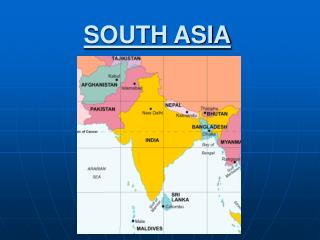
South Asia. EU and Morocco Review of North Africa & SW Asia Questions South Asia Scope and Features Major Qualities. THE REALM. Five Regions India Pakistan Bangladesh Mountainous North Southern Islands. Major Geographic Qualities of South Asia. Well defined physiographically


South Asia
E N D
Presentation Transcript
South Asia • EU and Morocco • Review of North Africa & SW Asia • Questions • South Asia • Scope and Features • Major Qualities
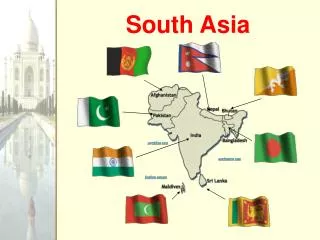
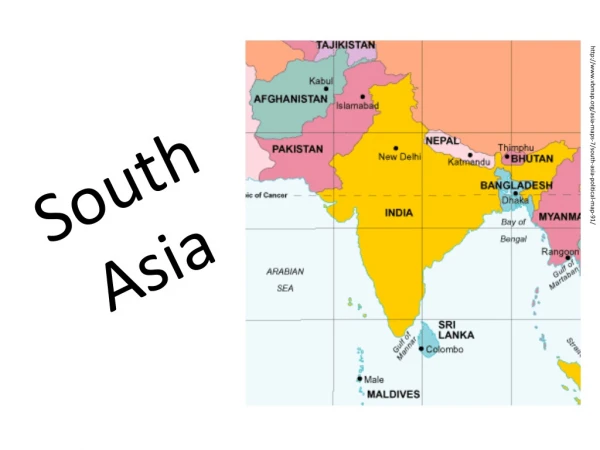
THE REALM Five Regions • India • Pakistan • Bangladesh • Mountainous North • Southern Islands
Major Geographic Qualities of South Asia • Well defined physiographically • Monsoon climate • The world’s second largest population cluster • 1.4 billion • Grinding poverty • 22% of world’s population, 3% of land area • Population concentrated in villages • North Indian Plain – Uttar Pradesh • British colonial legacy, India, a federal state • Religion and nationalism • Boundary issues • Kashmir
WHAT CLIMATE VARIABLES HELP TO EXPLAIN THIS DISTRIBUTION?
MONSOONS • Monsoon • India is the ‘textbook example’ • 50% of arable land irrigated by monsoon • Over half world’s population is in monsoonal regions • It is a wind, not the rain • Seasonal reversal of winds • General onshore movement in summer • General offshore flow in winter
Impact of the Monsoon • Regional variation • Vital to rice production in India • But: • Widespread flooding and property damage • Transportation • Housing • Erosion and destruction of agricultural land • Disease • Malnutrition • Death • Impact exacerbated by deforestation
Culture • Religion • Islam is dominant in Pakistan and Bangladesh. • But 150 million Muslims in India • Hinduism is dominant in India. • Sikhism in northern India, Punjab • Buddhism is dominant in Sri Lanka.
Culture Hearth: The Indus River • Early agriculture & hydraulic civilizations • Arts and trade routes emerged from isolated tribes and villages to towns and beyond. • Hinduism emerged from the beliefs and practices brought to India by the Indo-Europeans c. 600 BC • Buddhism – Prince Siddhartha 300 BC • Diffusion of Islam 700-1600 CE
The world’s oldest religion Culture hearth of the Indus River Valley Diffused south and east down the Ganges HINDUISM
HINDUISM • Intricate web of religious, philosophical, social, economic, and artistic elements • No common creed • No single doctrine • No direct divine revelation • No rigid narrow moral code • Caste system: rigid social stratification
Colonial Transformation 1 • East India Company – 1599 • Benefits from factionalization • Warring principalities • Islam-Hinduism-Buddhism • Drives out French, Dutch and Spanish rivals • Indian Mutiny (Sepoy Rebellion) of 1856 • British Viceroy assumes control 1857-1947
Colonial Transformation 2 • Benefits of Colonial Era • British civil service and public administration • Centralization of political control of rival states • Railway network • Irrigation canal network • Discouraged suttee, infanticide, child marriage • Costs of colonial era • Dependency and indignity • Resources extracted for Britain’s benefit • Independence and partition, 1947
PARTITION AND ISLAM Independence and Partition 15 million refugees