Understanding Link Contracts Through a Graphical Riddle
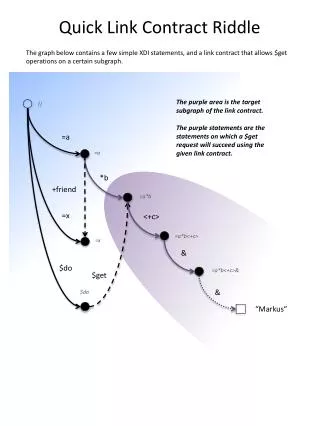
Dive into the nuances of link contracts with our engaging riddle! This graph highlights a variety of simple XDI statements and a link contract that facilitates $get operations on a specific subgraph. Explore the designated purple area, which represents the target subgraph, and discover which statements allow for successful $get requests. Additionally, we explore how link contract functionality interacts with $ref and $rep behaviors, challenging your understanding of these concepts. Are you ready to solve the riddle?

Understanding Link Contracts Through a Graphical Riddle
E N D
Presentation Transcript
Quick Link Contract Riddle The graph below contains a few simple XDI statements, and a link contract that allows $get operations on a certain subgraph. The purple area is the target subgraph of the link contract. () The purple statements are the statements on which a $get request will succeed using the given link contract. =a =a *b +friend =a*b =x <+c> =a*b<+c> =x & $do =a*b<+c>& $get & $do “Markus”
Quick Link Contract Riddle The graph below discuses a case where link contract functionality intersects with $ref/$rep functionality. The purple area is the target subgraph of the link contract. () The purple statements are the statements on which a $get request will succeed using the given link contract. [=] [=] !:uuid:1 [=]!:uuid:1 =a $ref =a *b $ref =b [=]!:uuid:1*b =b $ref =c =c $rep =d =d $do $get $ref/$rep behavior: Will a $get on =a*b succeed? Will a $get on =d*b succeed? $do