Understanding Logic: Statements, Truth Values, and Compound Statements
This section explores the fundamentals of logic, focusing on statements that can be true or false, represented by letters like p and q. Key concepts include truth value, negation, compound statements, conjunctions, and disjunctions. Learn to form logical statements and express their relationships using symbols. For instance, the statement "p: Detroit is a city in Michigan" is true, while its negation "~p: Detroit is not a city in Michigan" is false. Additionally, discover how to organize truth values using truth tables.

Understanding Logic: Statements, Truth Values, and Compound Statements
E N D
Presentation Transcript
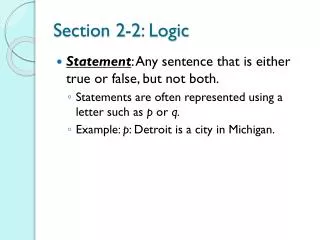
Section 2-2: Logic • Statement: Any sentence that is either true or false, but not both. • Statements are often represented using a letter such as p or q. • Example: p: Detroit is a city in Michigan.
Section 2-2: Logic • Truth Value: The truth or falsity of a statement. • Example: p: Detroit is a city in Michigan. • The above statement is True.
Section 2-2: Logic • Negation: A statement that has the opposite meaning as well as an opposite truth value. • Not p: Detroit is not a city in Michigan. • In this case, the above statement has a truth value of False. • Not p is shown as ~p.
Section 2-2: Logic • Compound Statement: Two statements that are joined. • p: Detroit is a city in Michigan. • q: Detroit is the capital of Michigan. • p and q: Detroit is a city in Michigan and Detroit is the capital of Michigan.
Section 2-2: Logic • Conjunction: a compound statement formed by joining two or more statements with the word and. • Symbols: p ^ q
Section 2-2: Logic • Disjunction: A compound statement formed by joining two or more statements with the word or. • Symbols: p V q
Section 2-2: Logic • Example: p: One foot is 14 inches q: September has 30 days r: A plane is defined by three noncollinear points. p^q ~q^r r^p ~p ^ r pVqqVr
Section 2-2: Logic • A convenient method for organizing the truth values of statements is to use a truth table.
Section 2-2: Logic • Homework: Pages 103-104, #11 – 29 odd