
Uploaded by
gerda
0 SLIDES
134 VIEWS
0LIKES
The Spark of World War I: Archduke Ferdinand's Assassination and Its Global Impact
DESCRIPTION
The assassination of Archduke Franz Ferdinand of Austria-Hungary ignited World War I in 1914, leading to a devastating conflict involving major world powers. The Allied Powers, including Belgium, Serbia, England, Russia, France, Italy, the U.S., and Japan, faced off against the Central Powers—Germany, Austria-Hungary, Bulgaria, and the Ottoman Empire. This global conflict transformed nations, reshaped borders, and set the stage for future geopolitical tensions. Discover the intricate alliances, battles, and consequences of this pivotal moment in history.
Download

1 / 0
Download Presentation 
The Spark of World War I: Archduke Ferdinand's Assassination and Its Global Impact
An Image/Link below is provided (as is) to download presentation
Download Policy: Content on the Website is provided to you AS IS for your information and personal use and may not be sold / licensed / shared on other websites without getting consent from its author.
Content is provided to you AS IS for your information and personal use only.
Download presentation by click this link.
While downloading, if for some reason you are not able to download a presentation, the publisher may have deleted the file from their server.
During download, if you can't get a presentation, the file might be deleted by the publisher.
E N D
Presentation Transcript
-
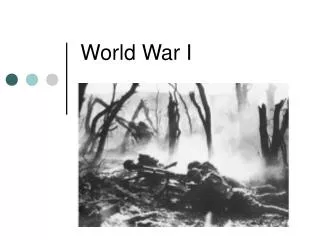
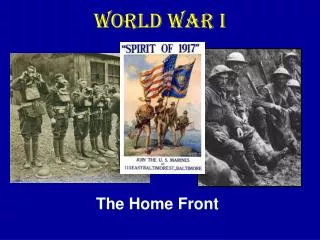
WORLD WAR I
-
The Spark:Assassination of Archduke Ferdinand of Austria-Hungary
- Allied Powers Belgium Serbia England Russia France Later Italy, and U.S. and Japan BSERF Central Powers Bulgaria Ottoman Empire Germany Austria-Hungary BOGA The Teams
- The Coaches Central Powers Franz Joseph, A-H Wilhelm II, Germany Allied Powers Czar Nicholas II, Russia, George Clemenceau, FR David Lloyd George, GB Woodrow Wilson, US
- Playing Field
- Eastern Front Mostly in Russia, along the German/Russian border More mobile Battle lines changed often (fluid) Western Front Mostly in France, along German/French Border Trench Warfare Stalemate – deadlock, where neither side gains an advantage War of Attrition – no quick victory; each side tries to wear the other side down Playing Field
- German Plans to Attack France
- German Plans to Attack France
- 1st Play: Schieffen Plan Schlieffen Plan – war plan for Germany, created by Alfred von Schlieffen Plan to avoid a two front war Attack France through neutral Belgium Defeat French in 6 weeks before Russia can mobilize Turn and fight Russia Problems: Heavily fortified areas in Belgium Strong resistance from France Russia mobilized quicker Britain attacked from the north
- 1st Game: Battle of the Marne German’s advance into France Pushed back by French at Marne Stalemate and Trench Warfare begin Ends Schlieffen Plan
- Which of the following correctly represents the Allied Powers Austria-Hungary, Italy, Germany, Serbia, Russia, France, Great Britain, Belgium Bulgaria, Ottoman Empire, Germany, Austria-Hungary Russia, France, Great Britain, Germany
- Which of the following describes the fighting on the western front? Trench warfare, Stalemate Mobile, Changing Battle lines Fought primarily in Russia Fought primarily in France Both 1 and 4 Both 2 and 3
- Which of the following describes the Schlieffen Plan and its failure? France’s plan to defeat Germany quickly; Belgium mobilized to quickly Germany’s plan to avoid a two front war; Russia mobilized too quickly Austria-Hungary’s plan to attack Serbia; Russia mobilized too quickly
- Trench Warfare
- Diagram of the Trenches
- Trench System
- Do you think we have enough food and supplies to outlast them? Do you think we have enough food and supplies to outlast them? No-Mans land These lines haven't moved for a year! These lines haven't moved for a year! French soldiers firing over their own dead All Quiet on the Western Front – trench warfare (9:27)
-
Battle of Verdun
German attack on French Longest battle of WWI (300 days) Total casualties – 700,000 No clear winner Stalemate - Battle of Somme British/French surprise attack against Germans British losses 1st day – 60,000 men Total Casualties – 1Million+ No clear winner Stalemate
- 1st Game Eastern FrontBattle of Tannenberg Russia vs. Germany Russian Advantages Largest army (15:1 ratio Russian to German) Not well trained Lacked weapons Russian Disadvantages Least industrialized Lack of Modern Technology Who won?
- Battle of Gallipoli
- Battle of Gallipoli Britain’s (Winston Churchill) Game Plan : Open supply route to Russia Capture Dardanelle Straight gaining access to Black Sea Eliminate the Ottoman Empire from the war Bulgaria and Ottoman Empire – promised land by A-H to defend Dardanelle’s at all cost Allies fail
-
Dogfights
- U-Boat
-
Poison Gas
-
Tanks
- Trenches
- America Enters WWI
-
America Neutral?
Not our war Businesses could sell to both sides Recent immigrants from both sides - Reason for US Entry Sinking of the Lusitania Zimmerman Note Unrestricted Submarine Warfare
- Sinking of the Lusitania German u-boat torpedoes British passenger ship off Irish coast 1200 die, 128 Americans
- Zimmerman Note Note from German Foreign Minister to German Ambassador to Mexico Convince Mexico to go to war against US Mexico to gain territory lost in Mex-Am War Prevent U.S. from joining war in Europe
- Unrestricted Submarine Warfare German u-boats sink military, passenger, and merchant ships on sight 4 US ships sunk between Jan-Mar 1917 US declares war: April 2, 1917
- US Entry into WWI
-
AmericaPrepares for War
-
America At War
American Expeditionary Forces “Dough Boys” http://www.firstworldwar.com/audio/overthere.htm - End of War Second Battle of the Marne (7/18) - Last Major German Offensive Kaiser Wilhelm II abdicates Armistice – Agreement to end fighting 11:00am 11/11/18
- Global War Resources and soldiers from colonies Fought in Asia and Africa - Allies gained German colonies British get help from Middle East colonies of Ottoman Empire conquered the Ottoman’s – expected independence at war’s end
- Lives Lost Russia 1,700,000* France 1,357,000 Great Britain 908,000 United States 130,174 Germany 1,800,000 Austria 1,200,000 Total Deaths 8-9M *Russia had the most total casualties Total Casualties 37M
-
Wilson’s Fourteen Points
Three Goals: Ensure lasting peace Right to choose government League of Nations – International body of representatives from each country with the purpose of maintaining peace - Paris Peace Conference 5 Separate Peace Treaties known as the Peace of Paris Central Powers not invited Big 4 - Allied Powers: Great Britain, US, France, Italy
- Germany got a R.A.W. Deal R.eparations – payments to victors for war damages ($33B) A.llied Punishments De-militarized Germany Took Germany’s colonies Gave Alsace Lorraine to France Took Saar Basin (coal supplies) Took Rhineland (buffer zone) W.ar Guilt – Germany had to accept total blame for the war Treaty of Versailles R. A. W.
- League of Nations Formed United States didn’t join Congress feared it would drag us into another war Weakened the power of the League of Nations No power to enforce its decisions
- Map of Europe Re-drawn Created by the Congress Of Vienna - created nationalistic feelings Yugoslavia – Serbia, Bosnia, Hertzegovenia Montenegro, Croatia, Slovenia
- WW ICausesWW II
- Which of the following was not a condition of the Treaty of Versailles Germany must take complete blame for the war Germany must pay reparations German colonies will become independent Germany must de-militarize
- Which of the following is true regarding the League of Nations? It was to act as a police force around the world It was to act as a world court It was to maintain international peace The U.S. didn’t join Both 1 and 2 Both 3 and 4
- Which country was Yugoslavia made from Germany Russia Austria-Hungary Ottoman Empire
- Why was WWI a cause of WWII It created resentment and anger among Russians It created anger and resent among Germans It was meant to be a peace among equals, but failed The US took too much territory

More Related