Joint Types and Movements for Better Health
90 likes | 137 Views
Explore different types of joints (synarthroses, amphiarthroses, diarthroses), common joint structures, types of diarthrotic joints, and joint movements like flexion, extension, rotation, and more.


Joint Types and Movements for Better Health
E N D
Presentation Transcript
Joints AKA Articulations
Kinds of joints • Synarthroses – no movement • Amphiarthroses – slight movement • Diarthroses – free movement
synarthroses • Fibrous connective tissue grows between the bones • No significant movement between bones • Ex.sutures
amphiarthroses • Cartilage connects the bones • Ex. Symphysis pubis, vertebrae • Herniated disk – when the disk between the vertebrae is pushed into the spinal canal and pushes on the spinal cord
diarthroses • Includes most joints, allows for movement
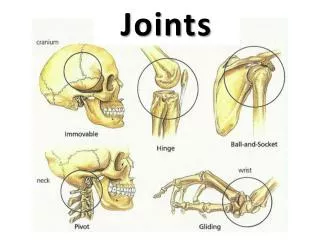
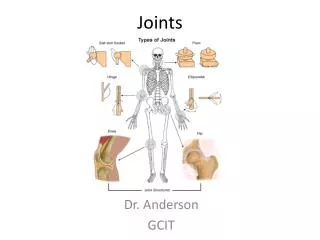
Types of diarthrotic joints • Ball and socket – hip and shoulder, widest range of motion • Hinge – movement in 2 directions (flexion and extension), elbow, knee, fingers • Pivot – small projection of 1 bone pivots in an arch of another (rotation) atlas/axis • Saddle joints – metacarpal bone of thumb and carpal bone, only 1 pair, opposable thumb • Gliding – least movable, gliding movements between vertebrae • Condyloid – oval projection fits in elliptical socket, wrist
Diartrotic joint structure • Joint capsule – fibrous connective tissue, fits over 2 connecting bones, lined with synovial fluid. • Ligament – connect bone to bone, fibrous connective tissue • Articular cartilage – layer over ends of bones, protection • Synovial membrane – secretes fluid, allows for easier movement, less friction
Joint movements • Flexion – reduce angle of joint • Extension –increase angle of joint • Rotation – spin a bone relative to another • Circumduction- moving distal end while keeping proximal end stable • Abduction – move away from midline, increase angle of joint • Adduction – moving part toward midline, decrease angle of joint