Earth’s Materials
120 likes | 324 Views
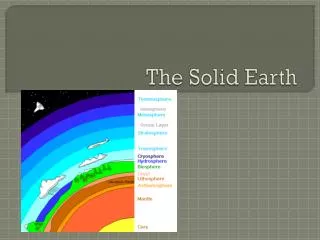
Earth’s Materials . Minerals. On the periodic table, of the first 92 elements: 90 are found in the Earth The crust is the outermost layer of Earth, and includes all continental material and materials that form the ocean bottom. Extends 10km beneath the continents.


Earth’s Materials
E N D
Presentation Transcript
Minerals • On the periodic table, of the first 92 elements: 90 are found in the Earth • The crust is the outermost layer of Earth, and includes all continental material and materials that form the ocean bottom. • Extends 10km beneath the continents
What’s a mineral? • A mineral is a naturally occurring element of compound that is inorganic, solid, and has a crystalline structure • Inorganic means that minerals are materials that are not produced by living organisms • The composition of minerals are indicated by their chemical formula • Example: Fluorite= CaF2
Physical Properties • A mineral has a particular chemical composition, although can sometimes vary due to small impurities • Example: Ruby vs. Sapphire
Example • Ruby vs. Sapphire • Both contain corundum, but Ruby has more chromium then Sapphire
Atom Arrangement • Some properties are controlled by orderly arrangement of atoms in a mineral’s structure • This pattern is what makes a mineral crystalline • The arrangement of atoms and the bonds between them can reflect the way a mineral breaks, how hard it is, and what type of crystal shape
How minerals break • Cleavage: the ability of a mineral break along plans that cut across relatively weak chemical bonds, a smooth, flat surface. • Fracture: an irregular break
Hardness • Bonds connecting atoms in materials often have different strengths • When your scratch a mineral with another mineral the scratch forms as bonds in the material are broken.
Luster and Streak • The way a mineral reflects light is known as luster • Metallic • Nonmetallic • The color of a mineral in powdered form is called streak • The streak may be the same color as the mineral