The Cold War in Asia: China and Korea (1945-1953)
Following World War II, China plunged into a civil war between the Nationalists and Communists, with significant U.S. support for the Nationalists led by Chiang Kai-shek. By 1949, the Communists, under Mao Zedong, emerged victorious, establishing the People's Republic of China, which the U.S. refused to recognize. The situation escalated into the Korean War when North Korea invaded South Korea in 1950. U.S. forces, initially responding under General MacArthur, faced a formidable Chinese intervention. The war led to a stalemate, and the division of Korea remains to this day.

The Cold War in Asia: China and Korea (1945-1953)
E N D
Presentation Transcript
Cold War Chapter 18 section2
China • 1945 • Northern China under Communist control • After WWII --- Nationalists and the Communists ceased cooperation • Civil War erupted • 1945 – 1949 • U.S. played peacemaker • Supported Nationalists • Chiang Kai-shek (leader) • $3 Billion = supplies • No soldiers
Two sides in China • Communists • Mao Zedong (leader) • Peasants support • Read / Write • Improve food production • Flocked to Communists‘ Red Army • Nationalists weak and corrupt • Chiang Kai-Shek fled to Taiwan • Relied on U.S. for aid • Failing economy • May 1949 • Communists ruled all of mainland China
Cont. • China’s New Government • People’s Republic of China • U.S. refused to recognize • Containment failed • Fear of Communism
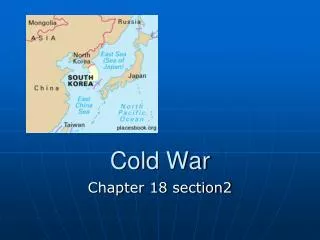
Korean War • Japan annexed Korea = 1910 • Ruled until August 1945 when war was over. • Korea Splits • 38th Parallel----- North Latitude • North Korea = Soviets = Communist • South Korea = US = Democratic
Korean War • June 25, 1950 • North Korea swept across the 38th Parallel • Korean Warbegins • June 27 • Truman ordered troops stationed in Japan to support South Korea • 16 nations sent 520,000 troops / aid • 90% - American troops • General Douglas MacArthur = commander of all forces
U.S. Fights • North Korea = Unstoppable at first • Driving deep into South Korea • MacArthur launched a surprise counterattack • Surrounded troops • Pushed North Korean troops across line and deep into North Korea
China Fights Back • China’s foreign minister warned • “his country would not stand idly by and let the Americans come to the border” • November 1950 • 300,000 Chinese troops joined the war • Wanted North Korea as a communist buffer state • Main opponents of war changed • China v. U.S.
Cont. • Chinese outnumbered UN forces • 10 to 1 • UN and South Korean troops pushed out of North Korea • Lost control of South Korean Capital • Seoul
MacArthur • 1951 • MacArthur wants to attack China • Nuclear weapons = Chinese cities • Truman rejected idea • Soviet Union = mutual-assistance pact with China • Did not want to start WWIII “Wrong war, at the wrong place, at the wrong time, and with the wrong enemy”
MacArthur Verses Truman • MacArthur continued to urge full scale war against China • Tried to go over presidents head • Spoke / wrote privately to newspapers / magazines • Refused warnings to follow orders • April 11, 1951 • Truman fired MacArthur
Stalemate • June 23, 1951 • Soviet Union suggested cease-fire = truce • Reached an agreement • Cease fire line = 38th parallel • demilitarized zone • Spent another year arguing over POW’s • July 1953 • Signed an armistice • Ending the War
Cont. • Agreement = Stalemate • Communism had been contained • No use of atomic weapons • Korea = 2 nations • 54,000 American causalities • Cost = $67 Billion • Increased fear of Communism in United States
The Korean war for Dummies http://www.youtube.com/watch?v=okQzZhL81tE