Understanding Parallelograms: Properties and Examples
This resource explores the definition and properties of parallelograms, focusing on their unique characteristics such as having two sets of parallel and congruent sides, congruent opposite angles, and supplementary consecutive angles. The resource includes worked examples involving the measures of angles and the coordinates of vertices. It also covers proving properties related to isosceles triangles within parallelograms. Through interactive problems and logical reasoning, learners can deepen their understanding of quadrilaterals and their relationships.

Understanding Parallelograms: Properties and Examples
E N D
Presentation Transcript
Parallelograms Unit 9, Lesson 2 & 3
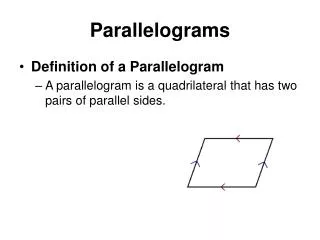
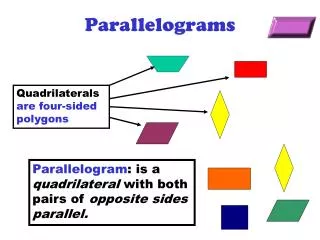
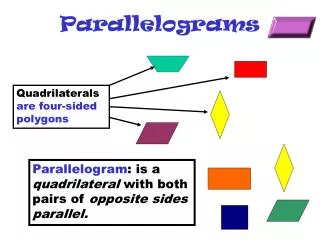
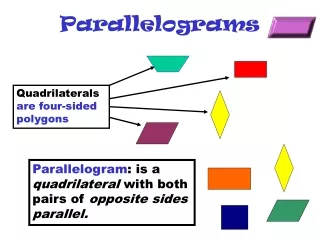
What is a parallelogram? • By definition, a parallelogram is a quadrilateral with both pairs of opposite sides parallel. • Parallelograms have: • 2 sets of parallel sides • 2 sets of congruent sides • opposite angles congruent • consecutive angles supplementary • diagonals bisect each other • diagonals form 2 congruent triangles
Example #1 • Complete each statement about parallelogram QRST. • Justify your answer. • ∠TSR is supplementary to _____.
Example #2 • Use parallelogram JKLM to find each measure or value. • m∠MJK = _____ • m∠JML = _____ • m∠JKL = _____ • m∠KJL = _____ E. a = _____ F. b = _____
Example #3 • Parallelogram GHJK has vertices G(-3, 4), H(1, 1), and J(3, -5). Which are possible coordinates for vertex K? • (-1, 1) • (-2, 0) • (-1, -2) • (-2, -1)
The following quadrilaterals are parallelograms. Solve for x and y. 4. 5. 6. x- 4 (y – 4) (3x + 3) 3y - 8 (x + 27) 2x - 12 3x - 6 3x – 16 3y + 2 x + 18
B A C E D Given:Parallelogram ACDE; Prove: Parallelogram ACDE Given Given Opposite sides of a parallelogram are congruent. Transitive property If two sides of a triangle are congruent, then the angles opposite them are also congruent.
A C B E D Given: Parallelogram ACDE; Prove:∆BDCis isosceles Parallelogram ACDE Given Given Opposite angles of a parallelogram are congruent. Transitive property ∆BDC is isosceles If 2 angles of a triangle are congruent, then the sides opposite them are also congruent. Definition of isosceles triangle