Understanding Parallelograms: Properties, Theorems, and Problem Solving
This resource provides a comprehensive overview of parallelograms, a unique type of quadrilateral characterized by having both pairs of opposite sides parallel. Discover key properties and theorems, such as the congruence of opposite sides and angles, and the bisection of diagonals. Engage with practice problems to reinforce your understanding, including finding values for variables in given geometric figures. Perfect for students looking to grasp the fundamentals of parallelograms and apply them in various mathematical contexts.

Understanding Parallelograms: Properties, Theorems, and Problem Solving
E N D
Presentation Transcript
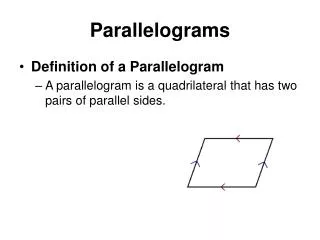
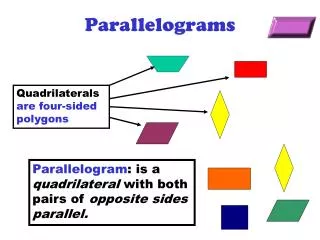
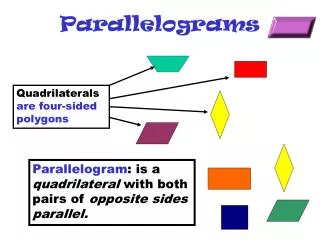
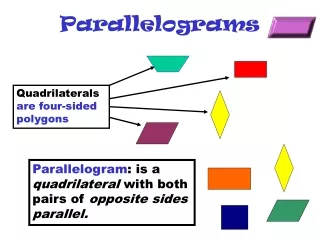
Definitions • Quadrilateral- polygon with 4 sides • Parallelogram- quadrilateral with both pairs of opposite sides parallel • Opposite sides- do not share a vertex • Opposite angles- do not share a side
Theorem 6-3 • Opposite sides of a parallelogram are congruent.
Theorem 6-4 • Consecutive angles of a parallelogram are supplementary • Why is this true? What kinds of angles are these (think about parallel lines cut by a transversal)?
Theorem 6-5 • Opposite angles of a parallelogram are congruent.
Theorem 6-6 • Diagonals of a parallelogram bisect each other.
Problem 3 (p.362) • Given: • KP=y+10 • MP=2x-8 • LP=x • NP=y+2 • Find x and y. • Find KM and LN. • y=14, x = 16, KM=48, LM=32
Theorem 6-7 • If three parallel lines cut off congruent segments on one transversal, then they cut off congruent segments on every transversal.
Complete the following questions about the diagram below. • If RS= 12, then ST= ______? • If AB= 8, then BC= ______? • If AC= 20, then AB= ______? • If AC= 10x, then BC=______? A R B S C T
Problem • Find x and y. • x=1.5; y=7 • Find DF and CA • DF=10, CA=12
Answer True or False(Remember, for a statement to be true, it must be true ALL of the time!) 1. Every parallelogram is a quadrilateral. True 2. Every quadrilateral is a parallelogram. False 3. All the angles of a parallelogram are congruent. False 4. All sides of a parallelogram are congruent. False 5. In RSTU, RS || TU. True 6. In ABCD, if m<A=50, then m<C=130. False
Homework • p.364 #9-12 all, 14, 15, 17-27 odd, 31, 38, and 39
Proofs with Parallelograms • p. 364 #13, p.365#32-37