Parallelograms
This lesson delves into the characteristics of parallelograms, highlighting critical properties including the congruence of opposite sides, congruent opposite angles, and supplementary consecutive angles. Students will learn that diagonals bisect each other and each diagonal creates two congruent triangles. Through examples involving specific parallelograms, such as quadrilateral RSTU and parallelogram JKLM, learners will apply these properties to find unknown lengths and angles. Enhance your understanding of these crucial geometric figures.

Parallelograms
E N D
Presentation Transcript
Parallelograms Advanced Geometry Polygons Lesson 2
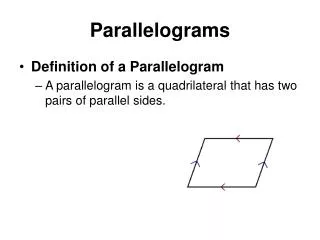
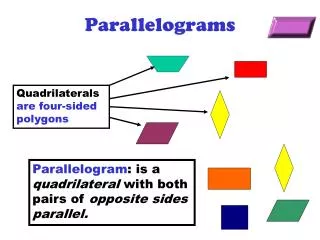
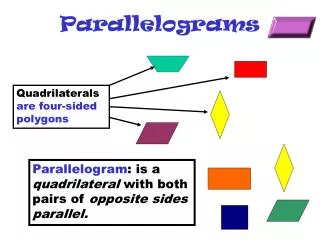
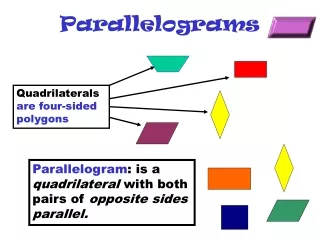
Parallelogram both pairs of opposite sides are parallel
Characteristics of Parallelograms • Opposite sides are congruent. • Opposite angles are congruent.
Characteristics of Parallelograms (cont.) • Consecutive angles are supplementary.
Characteristics of Parallelograms (cont.) • The diagonals of a parallelogram bisect each other.
Characteristics of Parallelograms (cont.) • Each diagonal separates the parallelogram into two congruent triangles.
Example: Quadrilateral RSTU is a parallelogram. Find RS, y, m∠UTR, m∠STU, and m∠RST.
Example: Parallelogram JKLM has diagonals and that intersect at N. If JN = 6x – 4, JL = 8x, NM = x + 3y, and KN = 2y + 7, find x, y, and KM.
Example: Use the definition of parallelogram to verify that quadrilateral LMNP is a parallelogram.
Characteristics Parallelogram • Def.: opp. sides parallel • opp. sides • opp. angles • consec. angles supp. • diagonals bisect each other • each diagonal creates triangles