Understanding Parallelograms: Properties and Examples
This document explores the properties of parallelograms, a special type of quadrilateral. Key properties include the congruence of opposite sides and angles, supplementary consecutive angles, and the fact that diagonals bisect each other. Through practical examples, we illustrate how to apply these properties to solve problems involving measurements and angle calculations in parallelograms. Understanding these foundational concepts is essential for mastering geometry.

Understanding Parallelograms: Properties and Examples
E N D
Presentation Transcript
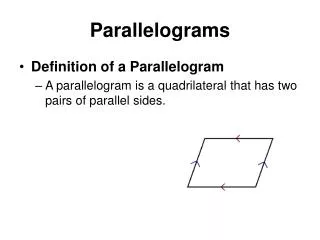
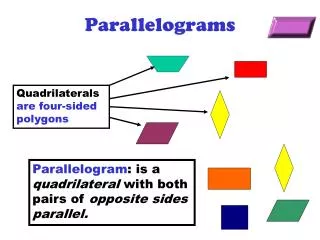
B C D A Parallelogram A quadrilateral whose opposite sides are parallel.
B C D A Properties of Parallelograms Opposite sides are congruent.
B C D A Properties of Parallelograms Opposite angles are congruent.
B C D A Properties of Parallelograms Consecutive angles are supplementary
B C D A Properties of Parallelograms Diagonals bisect each other
H K Examples M P L • Draw HKLP. • If HK = _______ and HP = ________ . • m<K = m<______ . • m<L + m<______ = 180. • If m<P = 65, then m<H = ____,m<K = ______ and m<L =____. • Draw in the diagonals. They intersect at M. • If HM = 5, then ML = ____ . • If KM = 7, then KP = ____ . • If HL = 15, then ML = ____ . • If m<HPK = 36, then m<PKL = _____ . PL KL P P or K 115° 65 115° 5 units 14 units 7.5 units alternate interior angles are congruent. 36;