Download
1 / 11
110 likes | 235 Views
This overview introduces the essential concepts of acids and bases. Acids, characterized by their sour taste, litmus paper reaction, and ability to donate hydrogen ions (H+), include substances like hydrochloric acid and vinegar. Conversely, bases are identified by their bitter taste, slippery feel, and capacity to accept hydrogen ions, represented by substances such as sodium hydroxide. We explore the Arrhenius and Brønsted-Lowry definitions, the pH scale for measuring acid-base strength, and neutralization reactions that produce water and salt.

E N D
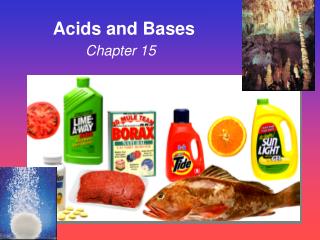
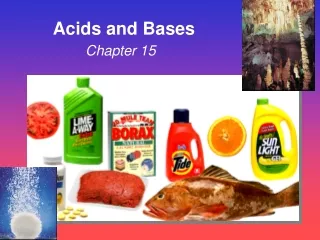
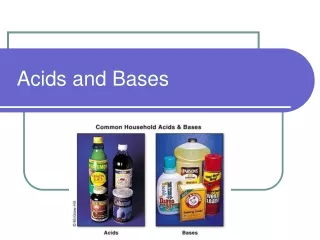
Acids • from the Latin word acere “sharp” or “sour” • taste sour (but you wouldn’t taste an acid to see) • change litmus paper red • corrosive to some metals (reacts to create hydrogen gas – H2) • a substance that can donate a hydrogen ion (H+) to another substance • create a hydrogen ion (H+) or hydronium ion (H3O+) when dissolved in water H2O Notice how the hydrogen ion is released when the acid is in water HCl H+ + Cl- Hydrogen ion Chloride ion Hydrochloric Acid Examples: hydrochloric acid, vinegar, lemon juice, rainwater
Bases • taste bitter (but you wouldn’t taste a base to see) • feel slippery or soapy • change litmus paper blue • react with oils and grease • a substance that can accept a hydrogen ion (H+) from another substance • create a hydroxide ion (OH-) when dissolved in water Notice how the hydroxide ion is released when the base is in water; this ion can accept a hydrogen ion (H+) H2O NaOH Na+ + OH- Sodium Hydroxide Sodium ion Hydroxide ion Examples: sodium hydroxide, Drano, Tums, baking soda
Acid/Base definitions Definition 1: Arrhenius Arrhenius acid is a substance that produces H+ (H3O+) in water Arrhenius base is a substance that produces OH- in water 4.3
Acid/Base Definitions Definition #2: Brønsted– Lowry Acids – proton donor Bases – proton acceptor A “proton” is really just a hydrogen atom that has lost it’s electron.
A Brønsted-Lowry acid is a proton donor. A Brønsted-Lowry base is a proton acceptor. conjugatebase conjugateacid base acid
ACID-BASE THEORIES The Brønsted definition means NH3 is aBASE in water — and water is itself anACID
Learning Check! Label the acid, base, conjugate acid, and conjugate base in each reaction: HCl + OH- Cl- + H2O Acid Base Conj.Base Conj.Acid H2O + H2SO4 HSO4- + H3O+ Conj.Base Conj.Acid Base Acid
The pH scale is a way of expressing the strength of acids and bases. Instead of using very small numbers, we just use the NEGATIVE power of 10 on the Molarity of the H+ (or OH-) ion.Under 7 = acid 7 = neutral Over 7 = base
Neutralization Reaction • occurs when acids and bases react with each other to produce water and salt • acids release a hydrogen ion (H+) and bases release a hydroxide ion (OH-) water (H2O) • the negative ion from the acid joins with the positive ion of a base salt HCl + NaOH H2O + NaCl Hydrochloric Acid (acid) Sodium Hydroxide (base) Sodium Chloride (salt) Water Both the salt and water are neutral substances; therefore, that is why this is referred to as a neutralization reaction.