Download
1 / 9
100 likes | 246 Views
This resource provides an overview of colonization, defining key terms and concepts related to the subject. It explores the meaning of a colony, the political, economic, and social factors driving colonization, and the historical context of various settler groups like the Pilgrims and Puritans. Key themes include the pursuit of religious freedom, the role of mercantilism, and the social hierarchies that influenced migration. This comprehensive guide is perfect for students studying the multifaceted implications of colonization in history.

E N D
Reasons for Colonization Vocabulary
Cornell Notes • What is Colonization? (noun)The act of one country claiming territory in a different location and sending its citizens to settle there. • What is a colony? (noun)A territory governed by a country in a different location. • What is political? (Adjective) related to government, laws, or use of military for power.
Cornell Notes • What is economic? (adjective) related to money and the exchange of goods and services • What is social? (adjective) related to how people live, work and interact with each other, family and community • What is religious? (adjective) related to faith or belief in a god or gods • What is persecution? (noun) the act of harassing or oppressing a person or group
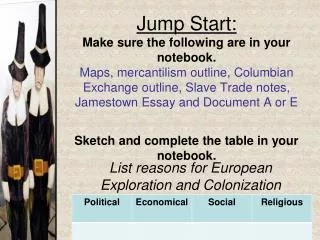
Political (bell) • Political freedom: make laws, choose representatives, vote • House of Burgesses - beginning of representative government, worked with the governor to make laws for the colony • Burgesses – representatives • Pilgrims – wrote the Mayflower Compact to govern themselves • Founders of Connecticut – The Fundamental Orders of Connecticut • First written constitution • Established town hall meetings to elect officials and discuss the needs of the colony
Religious (cross) • Religious Freedom – freedom to worship • Pilgrims/Separatists – wanted a new religion separate from the Church of England • Push to escape religious persecution, pull gain religious freedom • Puritans - Wanted to change the church to make it better • Purify the church of corruption • Quakers – All people had the inner light of God within them • Everyone was equal • Pacifists-peaceful, non-violent • Catholics – wanted to practice freely • Had to practice in secret in England
Economic (money bag) • Some settlers came in search of gold. • Mercantilism– use the colonies as a way to make money. Colonies would sell raw materials to England at cheap prices, then buy finished goods at higher prices. • Investors formed Joint stock companies to start a colony then give some of the profits to the king, becoming corporate colonies • Charter– a legal document granting power to someone • The king gave his friends charters to start their own colonies, and still earned some of their profits, known as proprietary colonies • Royal colonies – king controlled them himself, and would appoint a governor to send him his money
Social (ladder) • Hierarchy – ranking from highest to lowest • no movement in society in England • Middle and lower class – dreamed of a better life • Unemployed farmers – could own their land in America • Excess population – place for all the extra people • Debtors – crowding the prisons, wanted to pay off debts (money owed) • Some signed contracts as Indentured servants –work for 5-7 years as payment for passage • Gave people the opportunity to climb the social ladder based on hard work