Understanding Bridge Designs: Materials, Types, and Physics of Construction
Explore the fascinating world of bridge engineering, from various types such as girder, truss, cantilever, and suspension bridges, to the materials used like wood, concrete, and metal. This content delves into the physics behind bridge building, emphasizing design criteria including location, load capacity, and aesthetics. Learn about potential failures and the importance of understanding engineering vocabulary like live load, dead load, tension, and compression. Discover how thoughtful design leads to both functional and visually appealing structures.

Understanding Bridge Designs: Materials, Types, and Physics of Construction
E N D
Presentation Transcript
Bridges Designs, Materials & Types
Physics of Bridge Building • http://m.youtube.com/watch?v=ONInzuP5vO0&rdm=wqkyl1y&hl=en&gl=US&client=mv-google&guid= • A updated remix video: • http://m.youtube.com/watch?v=Sb6aAUhCtn4&desktop_uri=%2Fwatch%3Fv%3DSb6aAUhCtn4
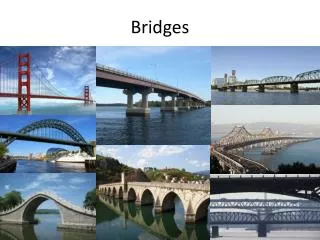
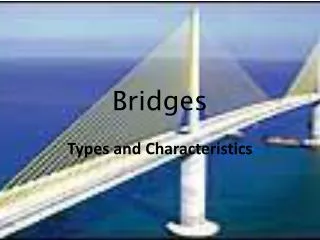
Bridge Types • Girder – deck supported by beams of reinforced concrete or steel, anchored at one end. Usually small spans or low load (force), based on strength of materials. • Truss/Cantilever – deck supported by a structure of beams of various materials, assembled in angles to disperse force between tension and compression. Materials depend on age of bridge, load (force) expected on the bridge and span. • Suspension – deck is supported by cables that hang from a main cable that goes from piers (abutments) to anchors on either end.
Where do the cars travel? Deck Design – traffic travels on top of the main structure. Pony Design – traffic travels through the structure, but the structure is not cross braced at the top. Through Design – traffic travels through the structure and the structure is cross braced at the top.
Materials – Planning for Epic Fail • Wood – wood is a natural polymer (like plastic), it can be pushed (compressed) or pulled (tension) and performs okay in either. • Concrete – very good in compression, not good in tension. Often “reinforced” by adding metal bars called rebar into the mold to help hold it together while under tension. • Metal – very good under tension (being pulled or twisted), but not good under compression. Metallic bonds create the ability to perform elastically (bending but maintaining shape) and plastically (bending to a new shape) without failing.
Design Criteria • Location LocationLocation – natural features, conditions, span, live load (traffic volume) • Failures: • https://www.youtube.com/watch?v=j-zczJXSxnw • http://www.youtube.com/watch?v=dGQfUWvP0II&app=desktop • (1/2) http://www.youtube.com/watch?v=YHT_Gz2fJuM • (2/2) http://www.youtube.com/watch?v=_lBgVJSyqwY&app=desktop
Design Criteria • Purpose – use of bridge. • Aesthetics – who will look at this, is this a gateway? • Successful: Time-lapse of Hoover Dam Bridge • http://www.youtube.com/watch?v=fu4_gY5TFOY&app=desktop • World's most dangerous road bridge. EXTREME • http://www.youtube.com/watch?v=zJqDyrZfJpI&app=desktop
Engineering Vocabulary • Live Load – weight of objects moving across it • Dead Load – weight of the structure • Moment – force that causes a rotation • Stress/Prestress – resistance of an object to an outside force • Shear – transverse perpendicular force • Tension – pull force • Compression – push force • Strain – deformation from force • Plastic – objected deflects far enough that it cannot return to previous form. • Elastic – object deflects but will return to orginal form. • Deflection – object bends or twists