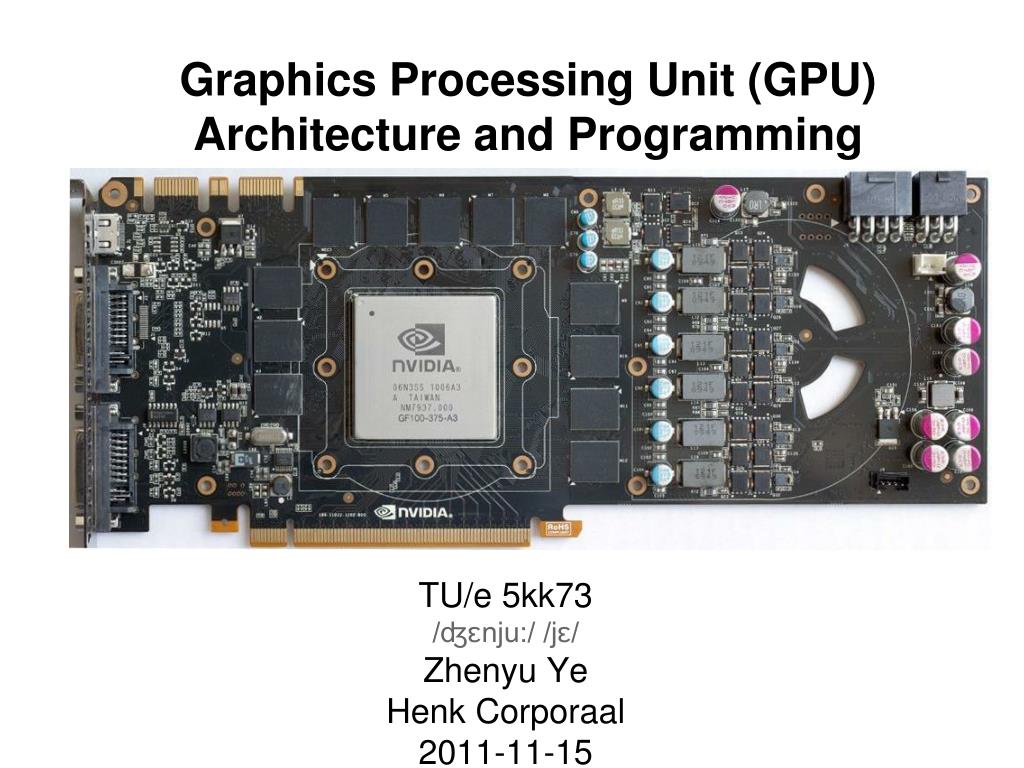
Graphics Processing Unit (GPU) Architecture and Programming. TU/e 5kk73 / ʤɛnju :/ / jɛ / Zhenyu Ye Henk Corporaal 201 1 -11- 15. System Architecture. GPU Architecture. NVIDIA Fermi, 512 Processing Elements (PEs). What Can It Do?. Render triangles.
01 / 53Graphics Processing Unit (GPU) Architecture and Programming
1 / 17
Download Presentation
Graphics Processing Unit (GPU) Architecture and Programming
An Image/Link below is provided (as is) to download presentation
Download Policy: Content on the Website is provided to you AS IS for your information and personal use and may not be sold / licensed / shared on other websites without getting consent from its author.Content is provided to you AS IS for your information and personal use only.Download presentation by click this link.While downloading, if for some reason you are not able to download a presentation, the publisher may have deleted the file from their server.During download, if you can't get a presentation, the file might be deleted by the publisher.
What Can It Do? Render triangles. NVIDIA GTX480 can render 1.6 billion triangles per second! • ref: "How GPUs Work", http://dx.doi.org/10.1109/MC.2007.59
The Gap Between CPU and GPU Application performance benchmarked by Intel. ref: "Debunking the 100X GPU vs. CPU myth", http://dx.doi.org/10.1145/1815961.1816021
Let's Start Again from C int A[2][4]; for(i=0;i<2;i++){ for(j=0;j<4;j++){ A[i][j]++; } } convert into CUDA • int A[2][4]; • kernelF<<<(2,1),(4,1)>>>(A); • __device__ kernelF(A){ • i = blockIdx.x; • j = threadIdx.x; • A[i][j]++; • } // define threads • // all threads run same kernel • // each thread block has its id • // each thread has its id • // each thread has a different i and j
What Is the Thread Hierarchy? • thread 3 of block 1 operates • on element A[1][3] • int A[2][4]; • kernelF<<<(2,1),(4,1)>>>(A); • __device__ kernelF(A){ • i = blockIdx.x; • j = threadIdx.x; • A[i][j]++; • } • // define threads • // all threads run same kernel • // each thread block has its id • // each thread has its id • // each thread has a different i and j
However, the Program Is Incorrect • kernelF<<<(1,1),(16,16)>>>(A); • __device__ kernelF(A){ • __shared__ smem[16][16]; • i = threadIdx.y; • j = threadIdx.x; • smem[i][j] = A[i][j]; // load to smem • A[i][j] = ( smem[i-1][j-1] • + smem[i-1][j] • ... • + smem[i+1][i+1] ) / 9; • }
Let's See What's Wrong • kernelF<<<(1,1),(16,16)>>>(A); • __device__ kernelF(A){ • __shared__ smem[16][16]; • i = threadIdx.y; • j = threadIdx.x; • smem[i][j] = A[i][j]; // load to smem • A[i][j] = ( smem[i-1][j-1] • + smem[i-1][j] • ... • + smem[i+1][i+1] ) / 9; • } Assume 256 threads are scheduled on 8 PEs. Before load instruction
Let's See What's Wrong • kernelF<<<(1,1),(16,16)>>>(A); • __device__ kernelF(A){ • __shared__ smem[16][16]; • i = threadIdx.y; • j = threadIdx.x; • smem[i][j] = A[i][j]; // load to smem • A[i][j] = ( smem[i-1][j-1] • + smem[i-1][j] • ... • + smem[i+1][i+1] ) / 9; • } • Assume 256 threads are scheduled on 8 PEs. • Some threads finish the load earlier than others. • Threads starts window operation as soon as it loads it own data element.
Let's See What's Wrong • kernelF<<<(1,1),(16,16)>>>(A); • __device__ kernelF(A){ • __shared__ smem[16][16]; • i = threadIdx.y; • j = threadIdx.x; • smem[i][j] = A[i][j]; // load to smem • A[i][j] = ( smem[i-1][j-1] • + smem[i-1][j] • ... • + smem[i+1][i+1] ) / 9; • } • Assume 256 threads are scheduled on 8 PEs. • Some threads finish the load earlier than others. • Threads starts window operation as soon as it loads it own data element. Some elements in the window are not yet loaded by other threads. Error!
How To Solve It? • kernelF<<<(1,1),(16,16)>>>(A); • __device__ kernelF(A){ • __shared__ smem[16][16]; • i = threadIdx.y; • j = threadIdx.x; • smem[i][j] = A[i][j]; // load to smem • A[i][j] = ( smem[i-1][j-1] • + smem[i-1][j] • ... • + smem[i+1][i+1] ) / 9; • } • Assume 256 threads are scheduled on 8 PEs. • Some threads finish the load earlier than others.
Use a "SYNC" barrier! • kernelF<<<(1,1),(16,16)>>>(A); • __device__ kernelF(A){ • __shared__ smem[16][16]; • i = threadIdx.y; • j = threadIdx.x; • smem[i][j] = A[i][j]; // load to smem • __sync(); // threads wait at barrier • A[i][j] = ( smem[i-1][j-1] • + smem[i-1][j] • ... • + smem[i+1][i+1] ) / 9; • } • Assume 256 threads are scheduled on 8 PEs. • Some threads finish the load earlier than others.
Use a "SYNC" barrier! • kernelF<<<(1,1),(16,16)>>>(A); • __device__ kernelF(A){ • __shared__ smem[16][16]; • i = threadIdx.y; • j = threadIdx.x; • smem[i][j] = A[i][j]; // load to smem • __sync(); // threads wait at barrier • A[i][j] = ( smem[i-1][j-1] • + smem[i-1][j] • ... • + smem[i+1][i+1] ) / 9; • } • Assume 256 threads are scheduled on 8 PEs. • Some threads finish the load earlier than others. • Till all threads • hit barrier.
Use a "SYNC" barrier! • kernelF<<<(1,1),(16,16)>>>(A); • __device__ kernelF(A){ • __shared__ smem[16][16]; • i = threadIdx.y; • j = threadIdx.x; • smem[i][j] = A[i][j]; // load to smem • __sync(); // threads wait at barrier • A[i][j] = ( smem[i-1][j-1] • + smem[i-1][j] • ... • + smem[i+1][i+1] ) / 9; • } • Assume 256 threads are scheduled on 8 PEs. All elements in the window are loaded when each thread starts averaging.
Review What We Have Learned 1. Single Instruction Multiple Thread (SIMT) 2. Shared memory • Vector SIMD can also have shared memory. • For Example, the CELL architecture. • Q: What are the fundamental difference between SIMT and vector SIMD programming model?
Take the Same Example Again • Assume vector SIMD and SIMT both have shared memory. • What is the difference? Average over a 3x3 window for a 16x16 array
Vector SIMD v.s. SIMT • kernelF<<<(1,1),(16,16)>>>(A); • __device__ kernelF(A){ • __shared__ smem[16][16]; • i = threadIdx.y; • j = threadIdx.x; • smem[i][j] = A[i][j]; • __sync(); // threads wait at barrier • A[i][j] = ( smem[i-1][j-1] • + smem[i-1][j] • ... • + smem[i+1][i+1] ) / 9; • } int A[16][16]; __shared__ int B[16][16]; for(i=0;i<16;i++){ for(j=0;i<4;j+=4){ movups xmm0, [ &A[i][j] ] movups [ &B[i][j] ], xmm0 }} for(i=0;i<16;i++){ for(j=0;i<4;j+=4){ addps xmm1, [ &B[i-1][j-1] ] addps xmm1, [ &B[i-1][j] ] ... divps xmm1, 9 }} for(i=0;i<16;i++){ for(j=0;i<4;j+=4){ addps [ &A[i][j] ], xmm1 }} Programmers schedule operations on PEs. • # of PEs in HW is transparent to programmers. • You need to know how many PEs are in HW. • Programmers give up exec. ordering to HW. • Each inst. is executed by all PEs in locked step. • CUDA programmers let the SIMT hardware schedule operations on PEs.
Review What We Have Learned Programmers convert data level parallelism (DLP) into thread level parallelism (TLP).