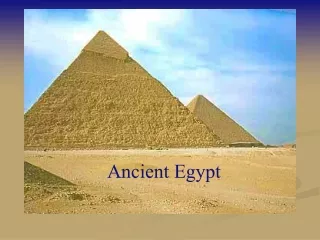
Ancient Egypt
This chapter explores the geographical location of Egypt on the northeastern coast of Africa, highlighting key features such as the 1st cataract of the Nile River and the Nile Delta, essential for agriculture due to its fertile soil and water supply. It introduces notable rulers like King Menes, who unified Egypt, and King Zoser, who commissioned the first step pyramid. The chapter also discusses Hatshepsut’s peace-oriented reign, Thutmose III’s military conquests, Ramses II's monumental temple building, and the social hierarchy in ancient Egyptian society.

Ancient Egypt
E N D
Presentation Transcript
Ancient Egypt Chapter 7 Grade 6
Where is Egypt located? • Egypt is located on the northeastern coast of Africa
What marked the southern boundary of Egypt? • The 1st cataract of the Nile River
What is the delta of the Nile River? • A marshy area near the Mediterranean Sea
What does the flooding of the Nile provide, which is important to Egypt’s agriculture? • soil & • water
Legend tells us that this king united upper and lower Egypt and designed a new crown to celebrate his victory. • King Menes
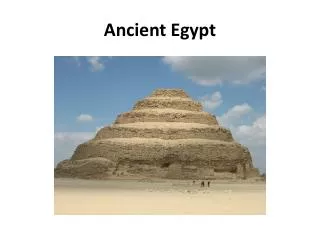
King Zoser • King Zoser’s chief adviser, Imhotep designed the first step pyramid
Hatshepsut: Egyptian Ruler • Became queen after death of Thutmose I • Supposed to be a temporary ruler • Believed in peace & prosperity
Thutmose III: Egyptian Ruler • Ruled after death of Hatshepsut • Believed in military conquest and expansion • Sought gold & copper from Kush
Ramses II: Egyptian Ruler • Built a temple with four huge statues of himself • Enlarged the empire
Kashta • Led Kush in breaking away from Egypt’s control • Extended his own empire
Shabaka • Ruled Egypt as 1st Kushite pharaoh • Kush located to south of Nubia
Kings Highest level, fewest people, some thought they were gods Officials & scribes Few more in #, helped kings Artisans & farmers Largest group in #, lowest class Triangle diagram Social Class System