Download

1 / 16
160 likes | 304 Views
This unit explores America’s transformation into a world power during the era of expansionism and World War I. It examines U.S. foreign policy, the implications of imperialism, and the responsibility that comes with power in global society. Key questions include the effects of new technologies on warfare, America’s involvement in global conflicts, and the dual perspectives on imperialism. The unit includes exploratory activities, vocabulary building, and a structured outline covering critical themes such as alliances, nationalism, and the socio-economic impacts of the war.

E N D
America Becomes a World Power Expansionism and World War I
Bell Work • In your passport… • Crete a tab for WWI • Make a table of contents page • Make a vocabulary Page: Define the following: • foreign policy • expansion • imperialism • annex • Monroe Doctrine • (be sure to leave yourself two pages for this as we build this unit)
Essential Questions • What responsibility does a world power have to the global society? • How did new technologies change the ways wars were fought? • What will you do with what you know?
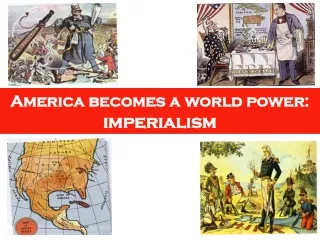
What is imperialism? Is it good or bad?
Imperialism: America’s Perspective Reasons against… Costly: $$ and lives Divided country Change in foreign policy Hypocrisy Reasons for… • Expand military forces • Economic gain • Racial superiority • Infusion of new cultures • Change in foreign policy
Imperialism: The country’s perspective Cons Loss of culture and traditions Devastation to land Economic loss Loss of lives New persecution Loss of freedom Pros • Freedom • Infrastructure: roads, highways, water, electric, communication • Education
Video and DQs America Becomes A World Power: Part I
World War 1“The Great War”1914-1918 “The price of greatness is responsibility.” -Sir Winston Churchill
Unit Outline • America’s Imperialism • Causes of the war • Alliances • The war at home • Technologies of the war • End of the war • 14 Point Plan • League of Nations • Treaty of Versailles
Life in Europe • Nationalism: a strong devotion to a national identity, including the desire for independence from foreign rule 2. Empire expansion. • Land/Resources • Arms Race • Expanded Military • No one wanted to be left behind 3. Alliance formation • Allied Powers: British, France, and Russia, America • Central or Axis Powers: German Austria-Hungary, and the Ottoman Empire
The Domino Effect Cause: Archduke Ferdinand from Austria-Hungary was assassinated. Domino effect: • Austria-Hungary declared war on Serbia, so… • Russia declared war on Austria-Hungary, so… • England and France aligned with Serbia, then… • Germany aligned with Austria-Hungary, and… • AmericajoinesAllied forces in 1917. • In total, 100 countries joined the war
Inquiry Activity: What should America Do? • In your groups, you will read a short passage and study some cartoons/ pictures from the perspective of either isolation or involvement - use the discussion questions to guide your inquiry. • Be prepared to discuss “your perspective” with the large group. • Use your time wisely – you have 15 minutes!!
Terms you may encounter: • Belligerent – hostile or aggressive; A nation or person engaged in war or conflict • Munitions - Materials used in war, especially weapons and ammunition. • Holocaust – a great or complete devastation or destruction, especially by fire. (Not to be confused with THE Holocaust which occurred during WWII)
Conclusion: • The United States entered The Great War in 1917 • The decision to get involved in Europe’s conflict marked the beginning of the United States as a “world power” • The argument between those who believe that the United States has a moral obligation to help solve world conflict and those who believe that the United States should “mind its own business” is still a major issue. • “The price of greatness is responsibility.” - Sir Winston Churchill
Class/Home Work • 1. Vocabulary: Nationalism, Militarism, Armistice, Alliance, u-boats • 2. Geography: Identify and label the Allied and Central Powers with map key. • 3. Read 27.6 – 27.8. Cornell Notes with the following questions: • What was America’s role before entering the war? • What made us eventually join the war? • What happened to Russia in the war? • What was our military strategy to help win the war?