Download
1 / 1
20 likes | 166 Views
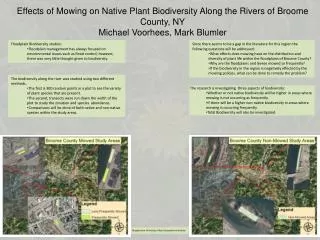
This research examines the impact of mowing on the distribution and diversity of native plant life in the floodplains of Broome County, NY. Historically, management has prioritized flood control over biodiversity, leading to significant knowledge gaps. Key questions addressed include: How does mowing affect plant diversity? Why is mowing practiced so frequently in these ecosystems? The study employs two methods—random point sampling and transects—to assess the variety and abundance of native versus non-native plant species, with the aim of understanding and potentially mitigating negative effects of mowing on biodiversity.

E N D
Effects of Mowing on Native Plant Biodiversity Along the Rivers of Broome County, NYMichael Voorhees, Mark Blumler • Floodplain Biodiversity studies: • Floodplain management has always focused on environmental issues such as flood control; however, there was very little thought given to biodiversity. • Since there seems to be a gap in the literature for this region the following questions will be addressed: • What effects does mowing have on the distribution and diversity of plant life within the floodplains of Broome County? • Why are the floodplains and levees mowed so frequently? • If the biodiversity in the region is negatively effected by the mowing policies, what can be done to remedy the problem? • The biodiversity along the river was studied using two different methods. • The first is 300 random points in a plot to see the variety of plant species that are present. • The second, transects were run down the width of the plot to study the zonation and species abundance. • Comparisons will be done of both native and non-native species within the study areas. • The research is investigating three aspects of biodiversity: • Whether or not native biodiversity will be higher in areas where mowing is not occurring as frequently. • If there will be a higher non-native biodiversity in areas where mowing is occurring frequently. • Total Biodiversity will also be investigated. • Binghamton University Urban Ecosystem Initiative