Arctic Hydrocarbon Reserves: Opportunities and Alternatives in Global Energy
130 likes | 246 Views
This report by Pauli Jumppanen, presented at the Rovaniemi Process in December 2013, discusses the potential of Arctic hydrocarbon reserves, estimating 1 billion barrels of oil and 2 trillion cubic meters of gas recoverable from this region. It examines the global need for Arctic hydrocarbons amid rising energy demands, the sustainability of fossil fuels, and the exploration of alternative energy sources. The report emphasizes renewable energy, synthetic fuel production from unconventional resources, and the challenges posed by environmental concerns and technological limitations in Arctic exploration.


Arctic Hydrocarbon Reserves: Opportunities and Alternatives in Global Energy
E N D
Presentation Transcript
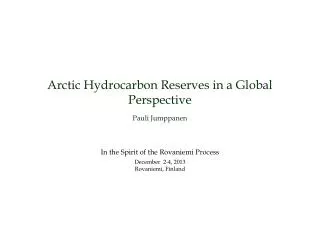
Arctic Hydrocarbon Reserves in a Global PerspectivePauli JumppanenIn the Spirit of the Rovaniemi ProcessDecember 2-4, 2013 Rovaniemi, Finland
ARCTIC HYDROCARBON RESOURCES (Source: USGS) Estimate for exploitable hydrocarbon reserves 1Bilion barrels of oil/condensate 2 Trillion cubic metres of gas 3Billion tons of oil equivalalent 4 % of oil yet to be found 5 % of existing conventional oil/gas reserves Bbl • Does world needs Arctic hydrocarbon reserves? • Are there alternatives to Arctic hydrocarbon development? Pauli Jumppanen2 – 4 . 12. 2013, Rovaniemi, Finland
WORLD POTENTIAL OF FOSSIL FUELS (Various sources) ← 1000 - 16,000 Btoe Billion tons of oil equivalent Sufficiency of recoverable fossil fuels (years) Pauli Jumppanen2 – 4 . 12. 2013, Rovaniemi, Finland
Fossil fuels Hydrocarbons Oil Natural gas & coalgas Coal Peat Nuclear energy Hydropower Renewables Biomass & biofuels Wind power Solar energy Wave and tidal energy Geothermal energy PRIMARY FUELS World fuels’ production 2012 (Source: BP June 2013) Pauli Jumppanen2 – 4 . 12. 2013, Rovaniemi, Finland
SYNTHETIC FUELS • Raw materials • Coal • Natural gas & coalgas • Shale gas & shale oil • Oil sands & bitumes • Biomass • Other • Conversion processes • Direct conversion • Pyrolysis • Hydrogenation • Plasma conversion • Indirect conversion • Fisher-Tropsch (FT) • Methanol to gasolin (MtG) • Other • Synthetic gases • Syngas • Hydrogen • Synthetic liquid fuels • Methanol • Dimethyl ether (DME) • Ethanol • Gasolin • Kerosene • Diesel & biodiesel • Fuel oils • Other Pauli Jumppanen2 – 4 . 12. 2013, Rovaniemi, Finland
WORLD PROVEN OIL RESERVES (Source: BP June 2013) 17,8 % 15.9 Heavy oils (Orinoco Belt) 10,4 Billion (109) barrels (Bbl) 9,5 9.0 7.9 Oil sands 6,1 5,9 5,2 2,9 Total oil 1669 Bbl R/P ratio 52,9 yr EU share 0.4 % 2,2 2.1 1,8 1,5 1.0 Oil company reserves (Ernst & Young 2012) • ExxonMobil 12.3 Bbl (0.73 %*) R/P = 15 yr • BP 10.6 Bbl (0.64 %*) R/P = 14 yr • Shell 6.1 Bbl (0,37 %*) R/P = 10 yr *Share of world reserves Pauli Jumppanen2 – 4 . 12. 2013, Rovaniemi, Finland
WORLD CONVENTIONAL NATURAL GAS RESERVES (Source: BP June 2013) 18.0 % 17,6 13.4 13,0 9.3 Trillion (1012) m3 (Tcm) 4.5 4.4 3.3 3.0 2.8 2.4 2.0 1.7 1.6 1.1 World total reserves: 187.3 trillion m3 • R/P ratio 55.7 years • OECD share 10.0 % • EU share 0.9 % Pauli Jumppanen2 – 4 . 12. 2013, Rovaniemi, Finland
WORLD SHALE GAS RESOURCES (Sources: EIA June 2013, ARI*) Technology (Horizontal drilling & hydraulic fracturing) 15.3 % 32.9 Tcm 14,7 11.0 9.7 9.2 Trillion (1012) m3(Tcm) 7.8 7.4 6.0 5.3 3.9 3.5 3.3 2.9 Technically recoverable shale gas resources: 206.8 trillion m3 Pauli Jumppanen2 – 4 . 12. 2013, Rovaniemi, Finland
NATURAL GAS PRICES 1995 - 2012 (Sources: BAFA, ICIS, Natural Gas Week) USD / million Btu (1 million Btu = 293 kWh ≈ 28 m3 natural gas) Pauli Jumppanen2 – 4 . 12. 2013, Rovaniemi, Finland
ALTERNATIVE OIL RESERVES RESOURCES (Various sources) Technically and economically recoverable oil - 53 v. Billion (109) barrels Pauli Jumppanen2 – 4 . 12. 2013, Rovaniemi, Finland
ALTERNATIVE GAS RESERVES AND RESOURCES (Various sources) Technically and economically recoverable gas - 56 v. Trillion (1012) m3 Pauli Jumppanen2 – 4 . 12. 2013, Rovaniemi, Finland
CONCLUSIONS • Out of Arctic hydrocarbon development, oil reserves are of major interest • Due to significant, good quality conventional oil reserves • Due to interest of some Arctic countries and big oil companies • To decrease dependence on Middle East and Latin Americ’s oil production • Out of Arctic natural gas reserves, only rich condensate fields are of a • short-term interest • Main alternative sources to Arctic hydrocarbons are: • Non-conventional resources like shale oil & gas, heavy oils, oil & gas sands etc. • Synthetic fuels production from shale gas, coal gas, biomass etc. • Renewable sources like biofuels, wind, solar, geothermal etc. • Arctic reserves’ development will proceed slowly due to technology • challenges, environment concerns and oil/gas price fluctuations Pauli Jumppanen2 – 4 . 12. 2013, Rovaniemi, Finland
THANK YOU ! Photo: Markku Lepola