Download
1 / 2
20 likes | 152 Views
Anabolism is crucial for constructing macromolecules from simple compounds, represented by the equation: Starting Compound (Monomer) + aATP + b NADH → End Product (Polymer/Macromolecule/Cell Component). Although similar to catabolism, the multitude of anabolic pathways makes the process complex and time-consuming. This lecture explores a simplified method for assessing anabolism by analyzing the oxidative state of cells compared to substrates and nutrients. By calculating the cell’s composite oxidation state, researchers can streamline the process of microbial growth and adaptation in varying conditions.

E N D
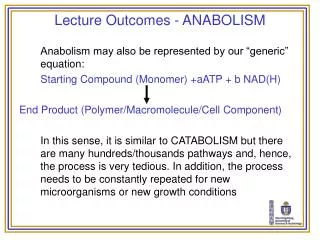
Anabolism may also be represented by our “generic” equation: Starting Compound (Monomer) +aATP + b NAD(H) End Product (Polymer/Macromolecule/Cell Component) In this sense, it is similar to CATABOLISM but there are many hundreds/thousands pathways and, hence, the process is very tedious. In addition, the process needs to be constantly repeated for new microorganisms or new growth conditions Lecture Outcomes - ANABOLISM
If this tedious process could be replaced with a more simple method, if would be advantageous. Such an overall method involves considering the composite oxidation state of the cell and comparing it with the oxidation state of the substrate(s) and nutrient(s) from which it came. The composite oxidation state of the cell may be easily calculated from the its elemental composition. The calculation then becomes a relatively simple process. Lecture Outcomes - ANABOLISM