Assertiveness Statements
Mastering communication in challenging situations can significantly impact relationships and problem-solving. This guide provides various approaches, including neutral statements that encourage understanding while recognizing differing perspectives. It emphasizes empathetic assertions that validate feelings while standing firm on your needs. The self-assertion technique empowers individuals to express their feelings and preferences. Finally, it proposes workable compromises that consider all parties' emotions, fostering collaboration. By employing these strategies, you can enhance your ability to communicate effectively and resolve conflicts amicably.

Assertiveness Statements
E N D
Presentation Transcript
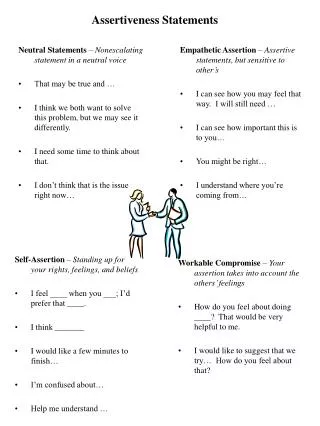
Neutral Statements – Nonescalating statement in a neutral voice That may be true and … I think we both want to solve this problem, but we may see it differently. I need some time to think about that. I don’t think that is the issue right now… Empathetic Assertion – Assertive statements, but sensitive to other’s I can see how you may feel that way. I will still need … I can see how important this is to you… You might be right… I understand where you’re coming from… Assertiveness Statements • Self-Assertion – Standing up for your rights, feelings, and beliefs • I feel ____ when you ___; I’d prefer that ____. • I think _______ • I would like a few minutes to finish… • I’m confused about… • Help me understand … • Workable Compromise – Your assertion takes into account the others’ feelings • How do you feel about doing ____? That would be very helpful to me. • I would like to suggest that we try… How do you feel about that?