Optimizing DC/DC Converters for HEP: Addressing Power Losses and Noise Challenges
In high-energy physics (HEP) experiments, efficient power delivery is crucial due to significant power drops in cables and limited material budgets. This discussion by Markus Friedl from HEPHY Vienna explores the challenges of providing low voltages required by modern electronics in CMS and ATLAS trackers, where up to 50% of power is lost in cables. Two primary methods, serial powering and DC/DC converters, are compared in terms of efficiency, design requirements, and application in future S-LHC upgrades. Further, the need for radiation-hardened designs for reliability in harsh environments is emphasized.

Optimizing DC/DC Converters for HEP: Addressing Power Losses and Noise Challenges
E N D
Presentation Transcript
B2GM, 14 March 2012 DC/DC Converters Markus Friedl (HEPHY Vienna)
What’s It All About? • We need to bring power to the front-end • There is a significant power drop in the cables • Limited space and material budget • Low voltages required by modern electronics • In CMS and ATLAS Trackers, ~50% of total power (tens of kW) is burnt in the cables I Rcable Rload Ploss = 2 x Rcable x I Rcable I Markus Friedl (HEPHY Vienna): DC/DC Converters
How to Avoid This? • Lower Rcable: hardly possible • Serial powering: deliver constant current at higher voltage, needs shunt regulator for each serially connected unit • DC/DC converters: deliver higher voltage, needs converter for each parallel unit • Both methods reduce I and thus power loss at constant Rcable Markus Friedl (HEPHY Vienna): DC/DC Converters
Serial Powering vs. DC/DC Converters • Both options have pros and cons and are intensively studied for S-LHC upgrades • Serial powering: • no common ground: requires level translation for I/O • generally easier for digital output – ATLAS • DC/DC converters: • switching device: requires careful design to avoid noise • generally easier for analog output – CMS Markus Friedl (HEPHY Vienna): DC/DC Converters
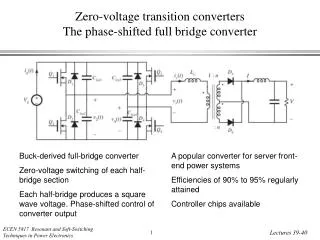
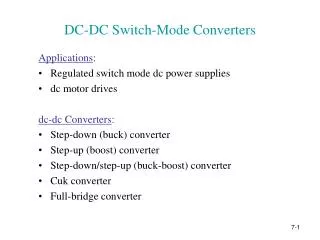
DC/DC: How Does It Work? • Buck converter (aka step-down converter): Essentially a kind of pulse width modulation of primary voltage, smoothened by LC filter • L, C: the bigger, the better • Higher switching frequency allows lower L,C values T1 open, T2 closed T1 closed, T2 open In reality, both switch and diodeare MOSFETtransistors Dutycycle D = t1,on/T; 1/D = Iout/Iin= Vin/Vout = r (K.Klein, Aachen) Markus Friedl (HEPHY Vienna): DC/DC Converters
DC/DC: Reality is Not Ideal • Efficiency is <100% (but much better than linear regulator) • Losses occur in several places: • Every coil has an Ohmic resistance • Ohmic resistance when MOSFET switch is on • Capacitive switching losses frequency • Control circuit also needs power • Typical DC/DC converters for our application have • Vin/Vout = 2..10, Iout = O(1A) • f = 1..5 MHz, switch Ron = O(10mW) • L = a few 100nH, coil RL = a few 10mW • Efficiency = 50..90% Markus Friedl (HEPHY Vienna): DC/DC Converters
DC/DC Challenges in HEP • DC/DC converters are very common (e.g. PC power supply), but we have some special issues in the front-end of HEP experiments • Radiation • Commercial integrated circuits are usually not rad-hard, they typically die after 10…100 kRad • Needs customized, rad-hard ASICs • Magnetic field • Presence of static B field saturates coil core • Needs air coil low L high switching frequency • Material budget • Needs small, light-weight materials • Noise emissions (conductive and radiated) • Needs proper circuit design, layout and shielding Markus Friedl (HEPHY Vienna): DC/DC Converters
R&D at CERN and Aachen • All those issues (previous page) are addressed, there are no showstoppers • CMS (and ATLAS) Tracker group have been studying the use of DC/DC converters for future S-LHC upgrade • CERN Microelectronics group is developing rad-hard DC/DC converter ASICs and air coils • Intensive tests with existing Tracker modules (APV25) and rad-hard DC/DC converter prototypes at Aachen Markus Friedl (HEPHY Vienna): DC/DC Converters
ASIC: AMIS Family • Being developed since 2007 • AMIS5 now being produced, expected back in summer 2012 AMIS4(almost final) 2.56 x 2.87 mm2 0.35µm ON Semiconductor (S. Michelis, CERN) Markus Friedl (HEPHY Vienna): DC/DC Converters
AMIS4 Measurements (S. Michelis, CERN) Efficiency vs. Iout Efficiency vs. TID 80…85% Rad-hard beyond 100Mrad Also tested: no SEB or SEGR Markus Friedl (HEPHY Vienna): DC/DC Converters
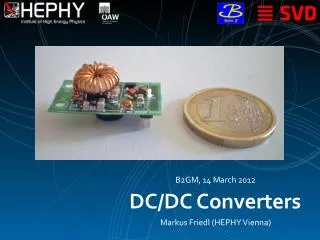
CERN DC/DC Module • Final AMIS chip not yet available, but substitute is • CERN group developed a DC/DC module (SM01C) based on commercial converter chip (LTC3605) with similar performance as AMIS, but not rad-hard • Optimized design & layout • Shielded air core coil • Available for tests • Chip will later be replaced by rad-hard AMIS ASIC SM01C Converter Module 13.5mm 28.4mm Markus Friedl (HEPHY Vienna): DC/DC Converters
Tests with DC/DC Converter and APV25 • Performed in Aachen (K. Klein et al) – references: appendix TEC petal 2 Converters (2.5V and 1.25V) very close toAPV25 chips Ring 6 modules 6.4 6.3 6.2 6.1 Motherboard Markus Friedl (HEPHY Vienna): DC/DC Converters
Impact on APV25 Noise (2009) (K. Klein, Aachen) • Noconverter • AC1 (2008) • AC2-StandardC with Mini Toroid • AC2-StandardC with Mini Toroid + filter 2 • Noise of (old) AC1 converterincreasedwithconversionratio r = Vin / Vout • AC2-StandardC with Mini Toroidand-filter exhibitsnosignificant additional noisefor all accessibleconversionratios APV25 + DC/DC work together without noise penalty! Markus Friedl (HEPHY Vienna): DC/DC Converters
Belle II SVD • Originally (TDR), we have forseenrad-hard voltage regulators close to the front-end (“Junction box”=DOCK box) Finesse Transmitter Board (FTB) FADC+PROC 1748APV25chips ~2mcoppercable Junctionbox ~10mcopper cable Unified opticaldata link (>20m) COPPER Front-endhybrids Rad-hardvoltageregulators Analog level translation,datasparsificationandhit time reconstruction Unified Belle IIDAQ system Markus Friedl (HEPHY Vienna): DC/DC Converters
Motivation for DC/DC @ Belle II SVD • Due to financial constraints, we have to re-use Kenwood power supplies of Belle I (SVD2) • Problem: • Belle I: 864 VA1TA chips, ~200W (+ repeater power) • Belle II: 1748 APV25 chips, ~600W • Existing Kenwood supplies are not sufficient for linear regulators & APV25, but more than enough with DC/DC • Now designing junction box with CERN DC/DC modules • Similar space requirements, less cooling needed @ DOCK Markus Friedl (HEPHY Vienna): DC/DC Converters
Summary & Outlook • Cable losses can be reduced by serial powering or DC/DC • DC/DC is baseline for CMS Tracker upgrade • CERN & Aachen are developing • Rad-hard ASIC, air core coils, shields, circuit and layout • APV25 + DC/DC converter: no noise penalty • Now designing Junction box with CERN DC/DC modules • Existing Kenwood power supplies are enough for future SVD • I will meet CERN guys in late April for discussion • Anyone (besided SVD) interested in DC/DC converters? Markus Friedl (HEPHY Vienna): DC/DC Converters
Some References • Wikipedia: http://en.wikipedia.org/wiki/Buck_converter • CERN Microelectronics: http://project-dcdc.web.cern.ch • K.Klein (Aachen): • https://indico.cern.ch/contributionDisplay.py?contribId=56&confId=49682 (2009) • https://indico.cern.ch/contributionDisplay.py?contribId=47&confId=104062 (2011) • F. Faccio, S.Michelis (CERN): • https://indico.cern.ch/contributionDisplay.py?contribId=92&confId=83060 (2010) • http://indico.cern.ch/getFile.py/access?contribId=39&sessionId=7&resId=0&materialId=slides&confId=113796 (2011) • https://indico.cern.ch/contributionDisplay.py?contribId=21&confId=120853 (2011) Markus Friedl (HEPHY Vienna): DC/DC Converters