Download
1 / 6
60 likes | 174 Views
In physics, work is defined by the conditions under which it is performed. Positive work occurs when a force causes displacement. Consider two swimmers at a meet: Swimmer A has a reaction time 0.01 seconds faster than Swimmer B. As the starting gun fires, Swimmer A dives into the water slightly earlier, gaining a crucial advantage. Both swimmers, despite having equal size and mass, exhibit the concept of power, which is the rate at which work is done. This example highlights the relationship between work, reaction time, and performance in sports.

E N D
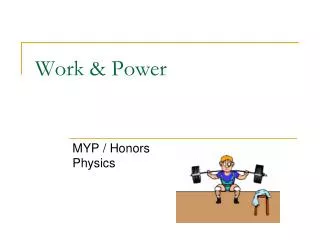
Work & Power MYP / Honors Physics
In the space below, write an example of work that you have done during your lifetime.
In the space below, write an example of work that you have done during your lifetime. Work: There are 2 conditions that must be met for positive work to be done on an object:
Consider two swimmers of equal size and mass at a swim meet. Both swimmers are on the starting block when the starting gun sounds. Swimmer A’s reaction time is 0.01s quicker than swimmer B when jumping of the starting platform. Both swimmers hit the water a swim to the opposite end of the pool where swimmer A beats swimmer B by 0.01s.
Power Power: Unit: