The Gas Laws
220 likes | 354 Views
This comprehensive overview of gas laws discusses key concepts such as pressure measurement using barometers and manometers, and the various units of pressure including atmosphere, kilopascal, torr, and PSI. The kinetic molecular theory explains gas behavior, while standard temperature and pressure (STP) provide a basis for comparisons. Key gas laws, including Boyle's, Dalton's, Charles's, and Avogadro's laws, highlight the relationships between volume, pressure, and temperature. Explore atmospheric pressure variations and their impact on the environment, emphasizing the significance of gas behavior in physical science.


The Gas Laws
E N D
Presentation Transcript
Measuring Pressure • Barometer • Manometer • Units: atmosphere, kilopascal, millimeter of mercury, Torr, Pound per square inches.
Pressure conversions • 1atm=760mmHg=101.3kpa=14.7psi
Atmospheric pressure (barometer) • 1 atm = 101.3 kpa = 760 torr = 14.7 psi =760 mmHg
Kinetic Molecular Theory • Gases are fluids • Gases have low density • Gases are highly compressible • Gases completely fill a container and exert pressure equally in all direction • Gases move faster in higher temperature
Atmosphere is a sea of gases • Atmosphere
The main gases of atmosphere • Percentages:
Atmospheric pressure • Pressure= force on a surface divided by the area of that surface. Its unit in SI Pascal. • Pascal = 1 Newton of force meter squared
Standard temperature and pressure • Standard temperature and pressure STP • STP = 0°C and 1 atm • At sea level the atmospheric pressure is equal to 1 atm. • Atmospheric pressure is lower in a higher altitude and higher in the valley
Pressure conversion • Convert 22 atm into Psi • 22atm X 14.7 psi = 323.4 Psi 1 atm Convert 73 kPa into torr 73 kPa X 760 torr = 547.7 torr 101,3 kPa
Green House effect Earth is becoming warmer
Ozone depletion and free radicals Free radicals such as Chlorine atom
Gas Laws • 1) Boyles law: The volume of a gas at constant temperature is inversely proportional to the pressure. P1V1 =P2V2
Problem • A sample of a gas has a volume of 100 mL when its pressure is 0.947 atm. What will the volume of the gas be at a pressure of 0.987 atm, if the temperature remains constant? P1V1 =P2V2 • 95.9 mL
Dalton’s Law (partial pressure) • The total pressure is equal to the sum of partial pressure. Ptot= P1+ P2 +…
Problem • At a certain temperature, the vapor pressure of water is 20 mmHg. A gas is collected over water at the same temperature at a total pressure of 720 mm Hg . The partial pressure of the gas in mmHg is.. • 700 mmHg or torr
Charles’s Law • The volume of a gas at constant pressure is directly proportional to the absolute temperature.
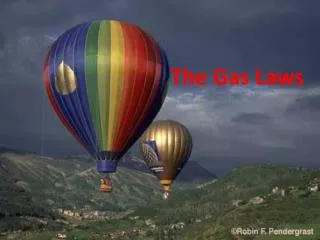
Charles’s Law • Hot air balloon
Problem • A gas has a volume of 18 centimeter cube at 25 degree Celsius. If the temperature is increased to 35 C at constant pressure, the new volume will be.. • (Hint) T→ Kelvin = 18.6 cm3
Avogadro’s Law • Gases with equal volumes under the same conditions have an equal number of molecules. • I mole of any gas at STP occupies 22.4 liter of volume. • 22.4 liter of any gas at STP has the same number of molecules or atoms
Problem • Calculate the density of oxygen gas at STP. • Density = mass = Molar Mass volume Molar Volume D = 32 = 1.43 g/cm3 22.4
A sample of oxygen gas has a volume of 7.84 cm3 at a pressure of 71.8 kPa and a temperature of 25 degrees Celsius. What will be the volume of the pressure changes to 101 kPa and the temperature goes down to 0 degrees Celsius? • The formula for combined law is • P1V1 = P2V2 T1 T2